You’re right. Let’s go further: Thoughts on the Impact Giving report sponsored by the Giving USA Foundation

You’re right. Let’s go further: Thoughts on the Impact Giving report sponsored by  the Giving USA Foundation Main Photo

20 Mar 2026


Tom's Takeaway

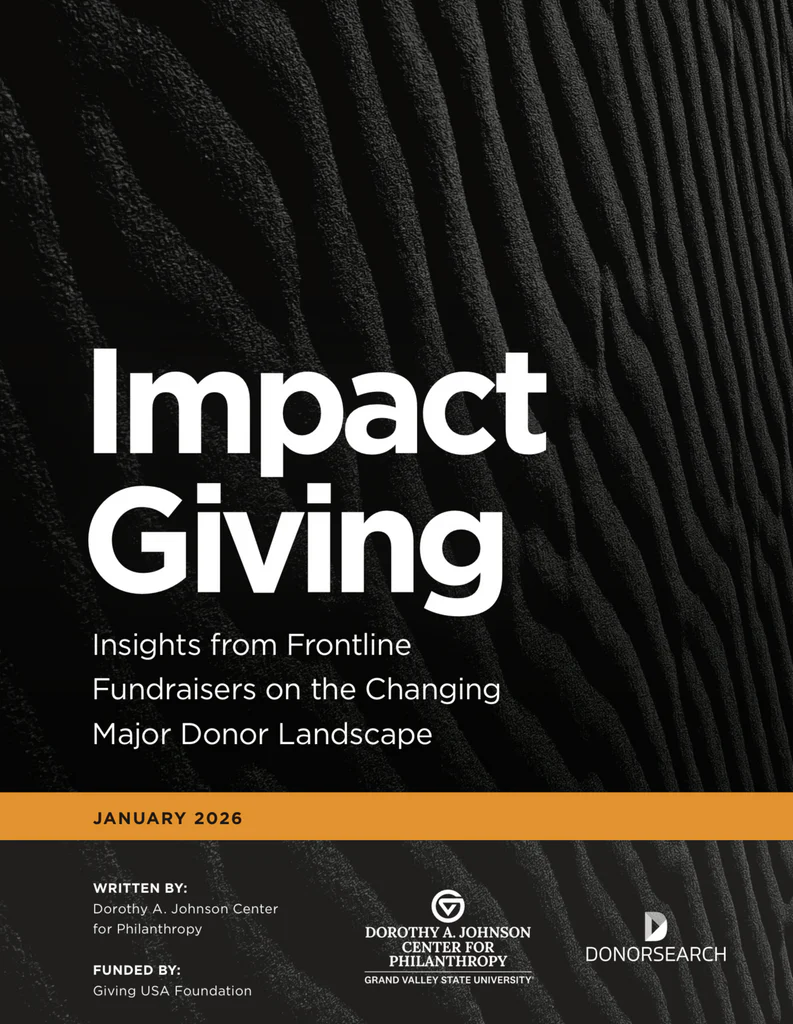
The Impact Giving report released recently by Giving USA was at once insightful, refreshing, and good for the ego.

Those of you that have read my posts/articles/books before know that for years I have been championing rational asks, quantifying outcomes, and the minority (to say the least) position that numbers don’t get in the way of fundraising… they enhance it. My recent rebuttals to the “facts tell, stories sell” camp have hopefully elevated the conversation to a better place in the industry. The release of the Impact Giving report, from one of the most respected institutions in the philanthropic world, is one of the few times in recent memory my position has been validated from an academic (read traditional) perspective.

The study was based on a survey of 229 frontline fundraisers, most of which (84%) were either development or executive staff at a nonprofit. They had a median of 20 years in fundraising overall, a median of 15.2 years in major gifts fundraising, and worked across the full range of causes. 

Now for the good stuff. Respondents identified three characteristics as the most prominent in the giving approach that they increasingly see taken by major donors, and I quote from the report:

  1. Major donors today are more focused on impact and measuring outcomes/results;
  2. Donors want to be more strategic and proactive; and,
  3. They are more interested in hands-on engagement with nonprofits.

Don’t let that first one slip away: major donors are more focused on impact and measuring outcomes/results. This is something we have been focused on for years, and the reason is simple…it works! Often this more outcome- focused approach has been pigeon-holed as too “for-profit oriented” or too “business-like.” Other times it’s been described as too cold. In all my 31+ years in the business, though, I have yet to meet a major Investor (preferred over donor, which is an entirely separate discussion) that did not want their money to achieve the outcomes they themselves valued. The more they value the outcomes the more they will invest and is often why “transformational rather than transactional” is often injected into the conversation.

Other points that merit attention:

  • The authors bundle these characteristics into an approach they call “impact giving.” To again quote the report, “This approach is characterized by a keen focus on making a measurable difference in communities and a drive to be more evaluative and engaged, rather than reactive and detached.”
  • This style of giving is not new and has grown in prevalence over the years.
  • Younger donors were seen as more likely to practice this approach, but it is used across the board.
  • The data represents more of an evolution than a revolution.

The handful of recommendations at the end of the report need to be emphasized as this evolution continues. These two major themes are vitally important if an outcomes-based approach is to be used successfully in the fundraising trenches.

  1. Communications need to be tailored to prioritize outcomes
    Not only should outcomes in general be the focus, but certain outcomes need to be directed to specific investors. Not all outcomes will be valued by every investor, because they naturally have their own interests and expectations. Just listing your outcomes (as opposed to outputs, again another topic) is not enough. Funders must believe they are investable and one must often put a value on them to make that point.
  2. “Listen and act on what you hear”
    Not actively listening to the investor, especially when you are asking for their money, is one of the most common ways to turn a major, transformational gift into a smaller, transactional donation. We have found that the key to a successful fundraising campaign, one which needs to be laced throughout the first step of a feasibility study, is really listening to what potential funders have to say. This is why the “survey” version of a feasibility study, and I am being gracious when I even call it a version, will not become the blueprint for a successful effort. A survey is neither a conversation nor an opportunity to cultivate a prospect. Not digging deeper into what motivates a
    prospect is a huge opportunity wasted.

The gist of the report is also reinforced by a somewhat new term in the fundraising vernacular, “evidence-based fundraising.” This might catch on more than the Rational Ask moniker often utilized in the past. For years, we have used the term Asking Rights TM , where outcomes are one of three necessary ingredients to earn the right to successfully ask for money. We are known for our Investment-Driven Model TM , a process where outcomes are emphasized to make investing in them more natural, connotes the same thing. It’s time that this outcome-based school of thought has a name. Maybe Impact Giving is it.

About The Author

Tom Ralser, CFA's Profile Photo

Tom Ralser, CFA

Principal & Director of The Outcomes Lab

Department: Team

“Why should I give your organization money?” 
 

When I began in this business in 1995, this is the question I was first asked to answer. Not only was this asked in my first feasibility study by a prospective donor, but from a company perspective, it became the driving question that would allow us to become leaders in the industry.

Since then, I have strived to not only address this question but improve and refine the answer. In the early days of economic development projects, it was relatively easy to answer. Since then, I have applied my approach to answering this question to virtually every type of nonprofit. The narrower term “ROI” has given way to the broader “OVP” (Organizational Value Proposition®) which is more appropriate for social missions and my focus on outcomes delivered has led to a revolution in addressing the motivations of givers, transforming them from nominal donors to major investors.

My work is not yet done. As investors in nonprofits become more sophisticated and demanding, the bar is continually being raised. Stay tuned.

Tom has worked with organizations of all kinds, from Chambers of Commerce to religious organizations, national museums to rural health networks, and local youth organizations to international research institutes. He pioneered applying ROI principles to nonprofit fundraising, an approach credited with helping organizations justify smarter, larger investments.

Hundreds of organizations have utilized Tom’s sustainability planning techniques to ensure they can thrive in a tight money environment. He holds the Chartered Financial Analyst (CFA) designation, which provides the framework for his Investment-Driven Model™  of fundraising, and led to the development of the Organizational Value Proposition®, which is widely used by corporations, foundations, and individuals as confirmation that the nonprofits in which they invest are truly delivering outcomes with values. Over three decades, his investment-driven methods have helped more than 650 nonprofits nationwide and contributed to an estimated $1.6 billion raised.

Tom is a nationally recognized expert in nonprofit sustainability and fundraising strategy. An avowed Outcomes Evangelist, Chartered Financial Analyst (CFA), author, and sought-after speaker, Tom brings for-profit discipline to nonprofit impact. We’re excited to have his expertise on our team.

Summary of Experience

  • Personally involved in over 650 nonprofit funding projects in all 50 states.
  • Author of the books ROI for Nonprofits: The New Key to Sustainability, Asking Rights: Why Some Nonprofits Get Funded (and some don’t), and the companion workbook, Developing Your Asking Rights.
  • Holds the Chartered Financial Analyst (CFA) designation, ranged by Economist as the “gold standard” for investment analysis.
  • Session leader and/or keynote speaker at dozens of conferences throughout the nonprofit sector and country. 
  • Founding Director of Western Colorado Bureau of Economic and Business Research at Colorado Mesa University, where he was a tenured professor.
  • MS in Finance from the University of Utah and BS in Marketing from Illinois State University.