Capitalizing on Strengths for Long-Term Fundraising Success
4 May 2026
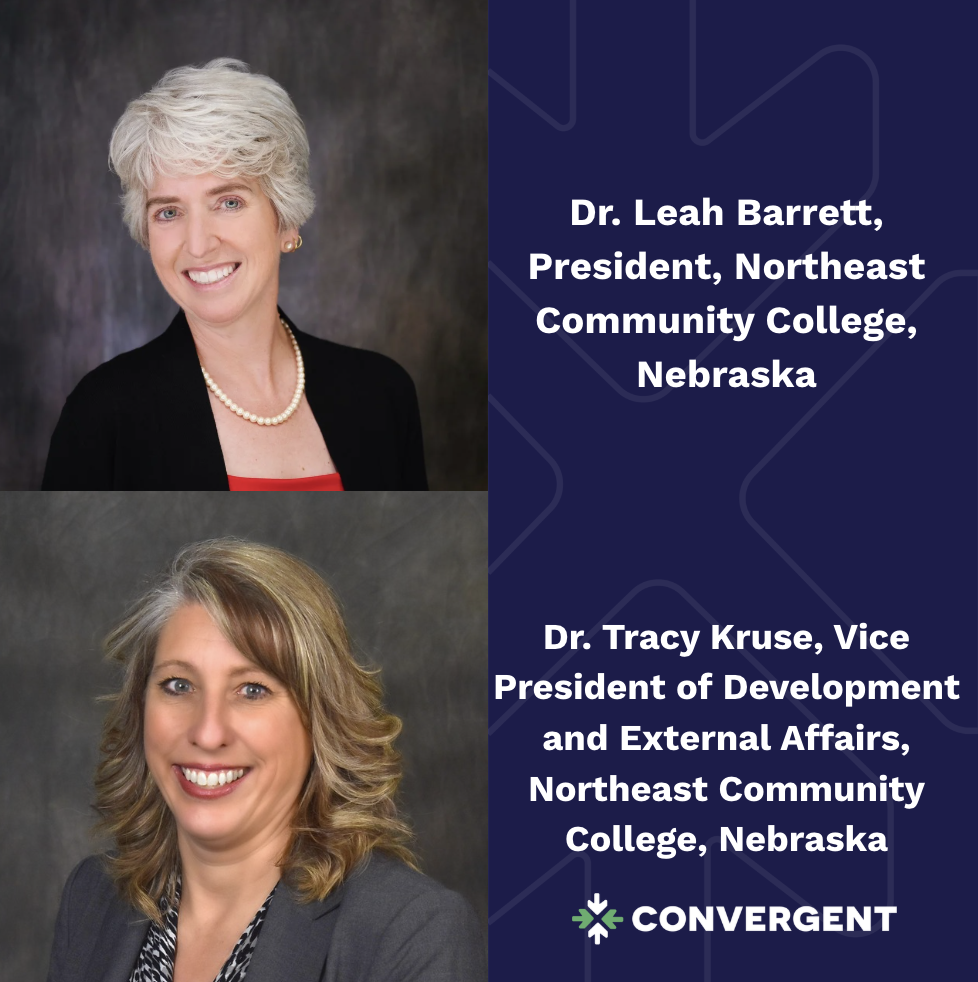
By Dr. Leah Barrett and Dr. Tracy Kruse
Northeast Community College (Northeast) serves a 20-county region in Northeast Nebraska, encompassing approximately 160,000 residents across nearly 14,400 square miles. The service area is made up primarily of rural communities. The college’s main campus is in Norfolk, the region’s largest population and economic center, with a population of approximately 26,000.
Northeast’s service area is one of Nebraska’s most productive farming and livestock regions. Agriculture and agribusiness form the backbone of the local economy, supported by thousands of family farms and agricultural operations. Complementing this agricultural strength, the region also maintains a robust rural manufacturing base that is closely tied to agriculture and transportation, as well as Nebraska’s growing bioeconomy. Local producers supply feedstocks for ethanol, biofuels, renewable natural gas, and other value added bioproducts, reinforcing agriculture’s role as both a food and energy source.
Agricultural producers and industry professionals rely on Northeast’s wide-ranging agriculture programs, including precision and mechanized agriculture, agronomy, agribusiness, and veterinary technology. Likewise, regional manufacturers depend on Northeast to prepare technically skilled workers in welding, industrial maintenance, Electrical mechanical systems, CNC machining, electrical construction and controls, diesel technology, truck driving, utility line work, and wind energy.
Over the past decade, Northeast has leveraged these core programming areas to attract new partners and significant external funding. Since 2015, the College has secured more than $100 million in support, including federal and state grants, private foundation funding, and corporate and individual contributions. More than half of these dollars have been raised specifically to expand Northeast’s agricultural offerings, resulting in two new agriculture facilities, three new agriculture programs, and increased capacity in a fourth agriculture program.
In addition, Northeast is the recipient of several USDA cooperative agreements that have supported the development and growth of a national consortium focused on two year agricultural education. This work recognizes the importance of community colleges in keeping pace with the rapidly evolving technology and innovation shaping the agricultural sector.
Now 29 colleges strong, the Community College Alliance for Agriculture Advancement (C2A3) is positioning itself as the only nationwide association devoted exclusively to supporting two year agriculture education professionals through resources, professional development, and networking. C2A3 and its members focus on the convergence of agricultural technologies, sustainable practices, and experiential student learning, creating new opportunities for Northeast to engage in national conversations with key industry stakeholders. These relationships are strengthening the College’s profile and positioning it for continued fundraising success while cementing its reputation as a leader in agriculture education.
“Northeast has doubled down on expanding the programs that will keep our region strong for years to come—leveraging our successes and building upon them,” said President Leah Barrett. “This includes offering short-term credentials and multiple entry and exit points for today’s learners.”
One example of this strategy, says Barrett, is the development of the iHub in downtown Norfolk, which strengthens the nexus between agriculture, ag technology, and manufacturing. The iHub houses workforce development training space for industrial automation, a youth robotics center, and a makerspace complete with woodworking, metals, and prototyping labs—all within a single facility. To date, the project has attracted more than $9 million in regional investment from federal and state grants, as well as corporate and philanthropic partners.
Additionally, the iHub’s colocated partnership with Invest Nebraska is expected to spur increased entrepreneurial activity and longterm economic opportunities. This work, alongside a partnership with the Nebraska Manufacturing Alliance to develop shortterm manufacturing credentials across all Nebraska community colleges, will be coordinated through the iHub and made accessible to learners statewide.
“We continue to build upon our expertise and reputation in core areas and use our brand to strengthen our fundraising capacity,” said Dr. Tracy Kruse, vice president of development and external affairs. This fall, Northeast plans to launch a comprehensive campaign aligned with the College’s newly developed strategic plan. More than 1,000 faculty, staff, students, and community members participated in the planning process over the past year.
With the launch of the new plan, Northeast is positioned to celebrate its past accomplishments, highlight its regional and statewide impact, and articulate a bold vision for the future.
“A comprehensive campaign is really nothing more than a coordinated brand awareness effort that can be leveraged by the College’s development team to support fundraising success,” Kruse said. “Rather than focusing on a single capital project with a limited donor pool, we can raise funds for multiple priorities simultaneously.” Kruse added that Northeast is shifting from a project focused approach to a Donor centered strategy, made possible by the strategic plan’s three key pillars. This structure allows the College to deepen relationships with donors, better understand their passions, and connect those interests directly to Northeast’s mission and longterm impact.
Dr. John Rainone - President, Mountain Gateway Community College, VirginiaDr. Anthony Wise - President, Pellissippi State Community College, TennesseeDr. Jo Alice Blondin - President, Clark State CollegeAt this year’s American Association of Community Colleges Annual Convention, one theme came through clearly in our session, Better Together: How Collaboration Can Drive...
AuthorsWe’re excited to introduce Quarterly Insights, a new resource for community college leaders grounded in the real conversations we’re having every day with presidents, boards, advancement teams, and workforce partners across the country. In a moment when colleges are navigating enrollment pressures, evolving workforce expectations, and ongoing funding uncertainty—all at once—we...
Dr. Mary A. Brumbach, CFRE(Ret.) Chief Strategy Officer, Dallas CollegeIn December of 1992 during the National Conference of the National Council for Resource Development (which eventually became the Council for Resource Development) a duty/task analysis chart was created by eight panelists and two facilitators using a modified DACUM (Develop A...
Share
Testimonials
Andrew Keenan
“The fact that Convergent could make the ask was huge. Working with our director and joining solicitations made me a better fundraiser – that was the right formula for us. Moving forward I feel much more confident in making asks and telling our story, and that is going to make us more sustainable in the long run.”
Andrew Keenan, Executive Director Callanwolde Fine Arts Center | Atlanta, GA
Lisa Zaken
“In the span of six short months, our Board went from being nervous about the initial campaign investment to being ecstatic with the attainment of our goal, and our subsequent stretch goal! Convergent can do it like no other. Their system is rigorous and extremely effective. We have nothing but great things to say about this organization!”
Lisa Zaken, President & CEO Leadership Gwinnett | Duluth, GA
Dion Davis
“The strategy and support offered by Convergent helped our Board expand its vision for the Foundation, which in turn helped to refocus and redefine our organization's impact in our community. The methodology behind their capital campaign process not only helps to raise more money in the immediate, but it also builds best practices for long-term investor relations and lays groundwork for the success of future funding initiatives.”
Dion Davis, Former Executive Director Jekyll Island Foundation | Jekyll Island, GA
Robin Mauck
“Working with Convergent has been a pleasure all the way around. Their approach is customized to your organization and their expertise is unmatched in the field. The Convergent team immersed themselves in our process, culture, and goals to provide exceptional value during our campaign. They truly walk alongside you every step of the way!”
Robin Mauck, Executive Director Obria Medical Clinics Gwinnett | Lawrenceville, GA
Aimee Hall
“I loved working with Convergent. I never could have done what Convergent did. If you want to run a successful campaign, you need to bring in that expertise. Thanks to their help, our capital campaign really took us to the next level within our community.”
Aimee Hall, Executive Director Safe Homes Domestic Violence Center | Augusta, GA
Phillip Aldridge
“I wanted to thank everyone from the Convergent team who assisted in our campaign. Of the varying ways the campaign’s success may be measured, I count it a blessing that we achieved what we did. Not just the funds committed but the contacts made, the level of exposure reached, and ultimately, what the funds and exposure mean in terms of how many more we now serve as a result. My thanks is in recognition and appreciation for Convergent serving as our fundraising counsel and for the patience and professionalism demonstrated throughout the campaign. You were a godsend for Valley Healthcare!”
Phillip Aldridge, Board Chair Valley Healthcare System | Colombus, GA
Jeff Taylor
“Early in our campaign feasibility study it became apparent that we lacked the Asking Rights necessary to conduct a capital campaign. As a result, Convergent’s knowledgeable consultants prepared an extensive plan of action that is a road map for growing our awareness and philanthropy. A successful capital campaign will be possible in the near future. Their entrepreneurial approach will definitely get you where you want to go.”
Jeff Taylor, CEO MedCura Health, formerly Oakhurst Medical Center | Stone Mountain, GA
Giving USA 2026 is being celebrated as a banner year. Look underneath the headline and a different story emerges — one that explains why an investment-driven approach to fundraising matters more now than at any point in the last 40 years.Americans gave a record $617.20...
Many nonprofits struggle with unpredictable fundraising cycles, relying on short-term grants, annual campaigns, and event-based revenue streams. This reactive approach leaves organizations vulnerable to economic shifts, grant expirations, and donor fatigue. Your nonprofit may be feeling this stress right now, given the uncertainty in federal...
With capital campaigns being multi-year commitments that can raise transformative funding for nonprofits, it’s natural that mission-driven organizations reach out to expert professionals for assistance with their upcoming campaigns. That’s where the capital campaign consultant can lend you their expertise and experience.Capital campaign consultants offer...
FOR IMMEDIATE RELEASEMarch 1, 2026For more information, contact:Brian Abernathy, General ManagerEmail: babernathy@convergentnonprofit.com Phone: 678.835.8735 ATLANTA, GA — At the International Economic Development Council Leadership Summit, March 1–3, Convergent announced its merger with Resource Development Group. Effective immediately, RDG will operate as RDG, a Convergent Company. This partnership unites...
Since nonprofit organizations rely on gifts from donors to support their mission, a thorough fundraising strategy is critical. However, even nonprofits with thorough funding plans run into obstacles at times, resulting in unmet goals and worries about sustainability and long-term plans.Whether you’re encountering times of...





.jpg)