Can Nonprofits Have Investors?: How to Fund for Your Future
21 Jun 2026
Fundraising
As a nonprofit leader, you know that to keep your organization afloat, you need to diversify your streams, including earning grants, executing capital campaigns, and securing major gifts. In your process of brainstorming revenue streams, you may not have considered one idea: investing.
In this article, we’ll explore whether nonprofits can legally have investors and whether they can choose to invest in stocks themselves. Then, we’ll provide our own take on this matter. Our stance is simple: We believe you already have investors—you just haven’t realized it yet.
Can a 501(c)(3) Organization Legally Have Investors?
The short answer is yes, 501(c)(3) organizations can legally have investors. But under IRS regulations, they can’t issue equity or ownership shares because technically, nonprofits have no owners.
Instead of stocks, nonprofit investors provide capital through alternative financial structures, such as:
Debt Financing (Loans): Investors lend money to the nonprofit, which repays them at a fixed, reasonable interest rate.
Tax-Exempt Bonds: Nonprofits can sometimes issue tax-exempt bonds that investors can purchase to fund large projects, such as building hospitals or schools. Just as with debt financing, bonds are repaid at low interest rates, and nonprofits typically use bank letters of credit or other forms of “credit enhancement” to secure the lowest possible interest rate.
Program-Related Investments (PRIs):PRIs are a type of investment that private foundations bestow on other charitable organizations for the purpose of furthering a charitable mission. A few examples of PRIs include low-interest or interest-free loans to students in need and high-risk investments in housing projects for low-income households.
Another workaround nonprofits use is a “hybrid” structure, which involves starting a sister for-profit subsidiary (usually a Limited Liability Company). With this hybrid approach, investors can put their money into the for-profit arm in exchange for equity, while the nonprofit maintains control over the mission-driven operations.
Can Nonprofits Invest?
While nonprofits can’t legally give equity to outside investors, they can actually be investors themselves. Most organizations prefer to invest in stocks, but some also invest in other types of assets, such as bonds, money market mutual funds, and Treasury Bills.
Nonprofit leaders and other industry professionals consider nonprofit investing a wise move, as it helps grow reserve funds and build long-term assets, effectively supporting the organization’s financial sustainability.
There’s only one caveat when it comes to nonprofit investing: the investments should not be used to benefit your nonprofit’s employees or board members.
How Does a Nonprofit Invest?
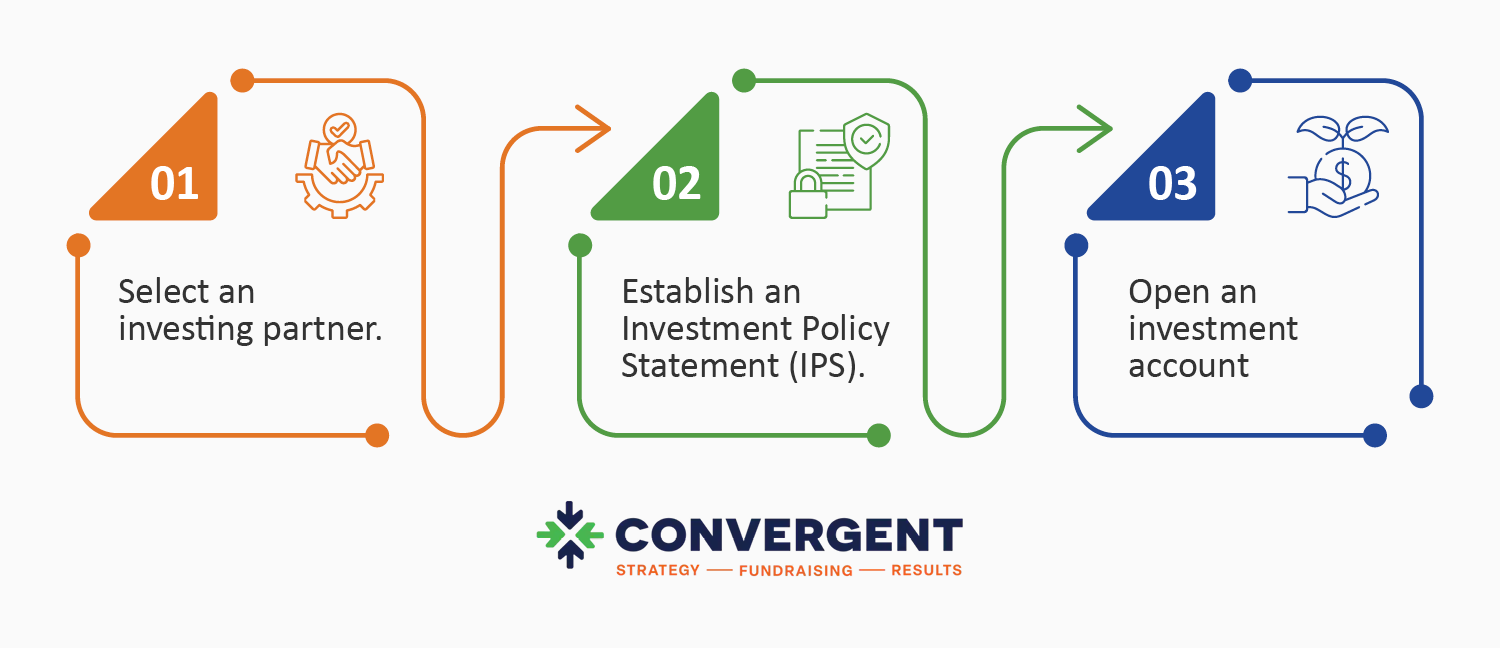
To start investing for your nonprofit, you generally have to take the following steps:
Select an investing partner. Not a lot of nonprofits have access to investment resources, so instead of handling investments yourself, it’s much better to have an outside partner who can help manage your portfolio. Big banks are the safest bet, but wealth advisors and brokers are great choices too.
Establish an Investment Policy Statement (IPS). An IPS outlines your organization's investment plans, helping you foster financial transparency among your supporters and protecting your board and finances. When developing an IPS, you need to include the investment committee's roles, investment objectives, spending policies, performance measurements, and reporting standards.
Open an investment account. To do this, you’ll need to submit an account application with essential information about your nonprofit (e.g., EIN and contact details), a copy of your Articles of Incorporation, a copy of your 501(c)(3) IRS Determination Letter, and a copy of your organization’s bylaws.
Once you have an open account, map out your investment strategies. Options like treasury bills and money markets are popular among nonprofits because they are low-risk, highly liquid investments, providing greater stability. Each type of asset has its own pros and cons, and your investing partner can educate you about them.
Reframing the Nonprofit Investor: The Convergent Stance
Getting started with nonprofit investing can be beneficial. But investing can also be tricky to navigate due to its complex processes. For that reason, we prefer to reframe the concept of a nonprofit investor.
At Convergent, we believe that you don’t have to look for angel investors, institutional investors, or venture capitalists to support your organization financially. You already have a base of passionate donors—they are your nonprofit investors!
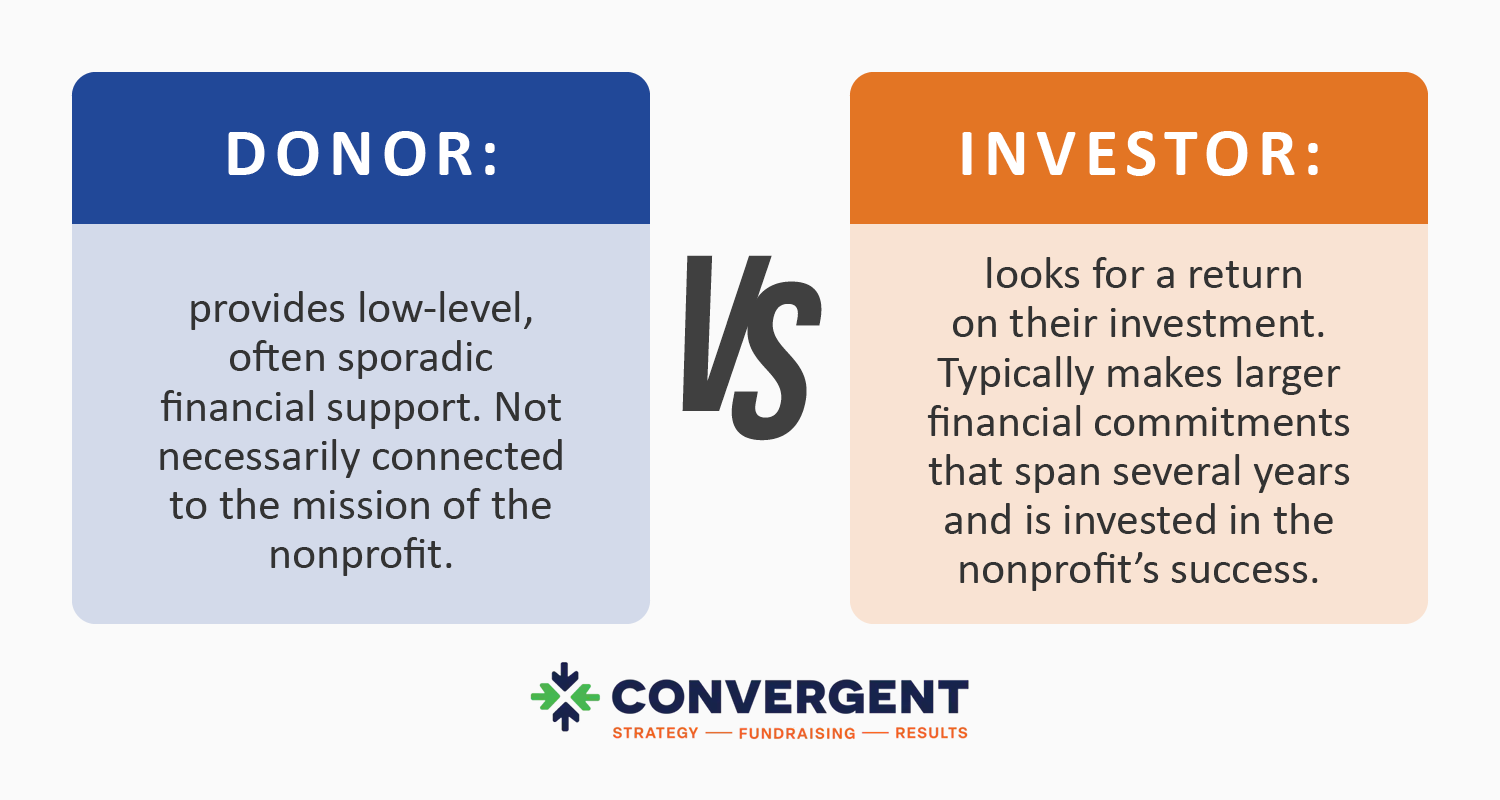
In my book Asking Rights, I argued the following definitions to differentiate between “donor” and “investor”:
Donor: An individual or organization that typically provides low-level (definition varies by nonprofit size, budget, funding model, etc.), often sporadic financial support that is not necessarily connected to the mission of the nonprofit.
Investor: A type of nonprofit funder who is looking for a return on their investment (often incorrectly referred to as a gift or donation). Although the term is more indicative of the mindset rather than the amount of money involved, an investor typically makes larger financial commitments that span several years. An investor is most concerned with the nonprofit's long-term success.
Another way to differentiate these two groups is in the questions they ask. When addressing the need for funding, donors will ask, “Have you demonstrated the need for your service?” while investors will ask, “How will funding your organization improve the situation?” Donors are motivated by emotional appeals, whereas investors focus on the transformational nature of charitable organizations.
Shifting to the Investor Mindset: The Key to a Sustainable Future
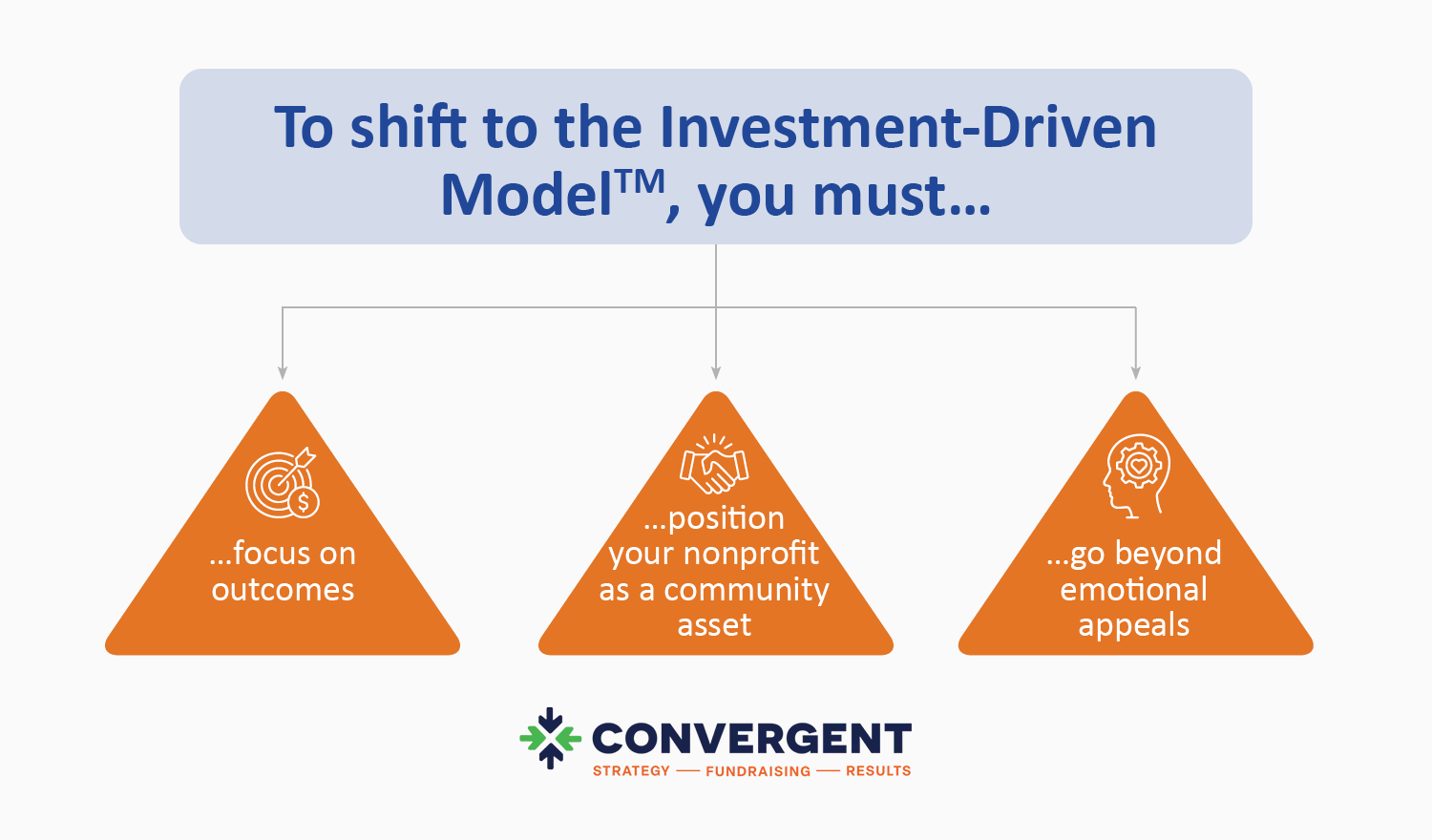
At Convergent, we believe that for your nonprofit to thrive and secure a sustainable future, you must shift to an investor mindset or, as we like to call it, the Investment-Driven ModelTM (IDM). The IDM highlights the importance of strategic alignment among fundraising objectives, delivered outcomes, and the nonprofit's overall mission.
To shift to the Investment-Driven ModelTM, you must:
Focus on outcomes: Show your investors the impact you will have on the lives of those you serve. Provide an Organizational Value Proposition® that your investors can’t resist.
Position your nonprofit as a community asset: By emphasizing the good work you do in the community, you’re proving that you’re an organization that’s worthy of investment.
Go beyond emotional appeals: Appealing to your investors’ emotions can help, but employing the often-overlooked rational component of decision-making takes this a step further. When you show the ROI of their investment to your organization, you’re making your case for support all the stronger.
How investors approach fundraising can be summed up by the following:
If you can’t demonstrate results (outcomes) or can’t make your outcomes meaningful to me, then you do not have the right to ask for my money.
Start Securing Investments With the Help of Convergent
When I began in this business in 1995, this is the question I was first asked to answer. Not only was this asked in my first feasibility study by a prospective donor, but from a company perspective, it became the driving question that would allow us to become leaders in the industry.
Since then, I have strived to not only address this question but improve and refine the answer. In the early days of economic development projects, it was relatively easy to answer. Since then, I have applied my approach to answering this question to virtually every type of nonprofit. The narrower term “ROI” has given way to the broader “OVP” (Organizational Value Proposition®) which is more appropriate for social missions and my focus on outcomes delivered has led to a revolution in addressing the motivations of givers, transforming them from nominal donors to major investors.
My work is not yet done. As investors in nonprofits become more sophisticated and demanding, the bar is continually being raised. Stay tuned.
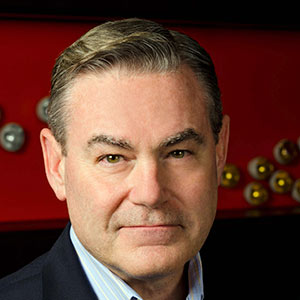
Tom has worked with organizations of all kinds, from Chambers of Commerce to religious organizations, national museums to rural health networks, and local youth organizations to international research institutes. He pioneered applying ROI principles to nonprofit fundraising, an approach credited with helping organizations justify smarter, larger investments.
Hundreds of organizations have utilized Tom’s sustainability planning techniques to ensure they can thrive in a tight money environment. He holds the Chartered Financial Analyst (CFA) designation, which provides the framework for his Investment-Driven Model™ of fundraising, and led to the development of the Organizational Value Proposition®, which is widely used by corporations, foundations, and individuals as confirmation that the nonprofits in which they invest are truly delivering outcomes with values. Over three decades, his investment-driven methods have helped more than 650 nonprofits nationwide and contributed to an estimated $1.6 billion raised.
Tom is a nationally recognized expert in nonprofit sustainability and fundraising strategy. An avowed Outcomes Evangelist, Chartered Financial Analyst (CFA), author, and sought-after speaker, Tom brings for-profit discipline to nonprofit impact. We’re excited to have his expertise on our team.
Summary of Experience
Personally involved in over 650 nonprofit funding projects in all 50 states.
Author of the books ROI for Nonprofits: The New Key to Sustainability, Asking Rights: Why Some Nonprofits Get Funded (and some don’t), and the companion workbook, Developing Your Asking Rights.
Holds the Chartered Financial Analyst (CFA) designation, ranged by Economist as the “gold standard” for investment analysis.
Session leader and/or keynote speaker at dozens of conferences throughout the nonprofit sector and country.
Founding Director of Western Colorado Bureau of Economic and Business Research at Colorado Mesa University, where he was a tenured professor.
MS in Finance from the University of Utah and BS in Marketing from Illinois State University.
Economic development organizations (EDOs) now operate in a markedly different environment than five years ago. Population changes, labor fluctuations, housing pressures, and infrastructure demands impact communities of all sizes. Expectations have evolved, with business leaders, officials, and residents seeking EDO engagement on issues beyond business attraction and marketing.Traditional economic development...Continue Reading
Nonprofit leaders are under more pressure than ever to show real results while dealing with fundraising challenges, staff shortages, and increasing community needs. Many still depend on annual campaigns, events, and donor appeals, but these often yield unpredictable results and slow long-term growth. This approach puts too much at risk.At...Continue Reading
By: Brian Abernathy, General Manager of ConvergentIn a rapidly changing philanthropic landscape, nonprofits can no longer afford to rely on a one-size-fits-all fundraising strategy. As older generations transition into retirement and younger demographics step into their peak earning years, understanding the nuances of who is giving — and why —...Continue Reading
Share
Testimonials
Andrew Keenan
“The fact that Convergent could make the ask was huge. Working with our director and joining solicitations made me a better fundraiser – that was the right formula for us. Moving forward I feel much more confident in making asks and telling our story, and that is going to make us more sustainable in the long run.”
Andrew Keenan, Executive Director Callanwolde Fine Arts Center | Atlanta, GA
Lisa Zaken
“In the span of six short months, our Board went from being nervous about the initial campaign investment to being ecstatic with the attainment of our goal, and our subsequent stretch goal! Convergent can do it like no other. Their system is rigorous and extremely effective. We have nothing but great things to say about this organization!”
Lisa Zaken, President & CEO Leadership Gwinnett | Duluth, GA
Dion Davis
“The strategy and support offered by Convergent helped our Board expand its vision for the Foundation, which in turn helped to refocus and redefine our organization's impact in our community. The methodology behind their capital campaign process not only helps to raise more money in the immediate, but it also builds best practices for long-term investor relations and lays groundwork for the success of future funding initiatives.”
Dion Davis, Former Executive Director Jekyll Island Foundation | Jekyll Island, GA
Robin Mauck
“Working with Convergent has been a pleasure all the way around. Their approach is customized to your organization and their expertise is unmatched in the field. The Convergent team immersed themselves in our process, culture, and goals to provide exceptional value during our campaign. They truly walk alongside you every step of the way!”
Robin Mauck, Executive Director Obria Medical Clinics Gwinnett | Lawrenceville, GA
Aimee Hall
“I loved working with Convergent. I never could have done what Convergent did. If you want to run a successful campaign, you need to bring in that expertise. Thanks to their help, our capital campaign really took us to the next level within our community.”
Aimee Hall, Executive Director Safe Homes Domestic Violence Center | Augusta, GA
Phillip Aldridge
“I wanted to thank everyone from the Convergent team who assisted in our campaign. Of the varying ways the campaign’s success may be measured, I count it a blessing that we achieved what we did. Not just the funds committed but the contacts made, the level of exposure reached, and ultimately, what the funds and exposure mean in terms of how many more we now serve as a result. My thanks is in recognition and appreciation for Convergent serving as our fundraising counsel and for the patience and professionalism demonstrated throughout the campaign. You were a godsend for Valley Healthcare!”
Phillip Aldridge, Board Chair Valley Healthcare System | Colombus, GA
Jeff Taylor
“Early in our campaign feasibility study it became apparent that we lacked the Asking Rights necessary to conduct a capital campaign. As a result, Convergent’s knowledgeable consultants prepared an extensive plan of action that is a road map for growing our awareness and philanthropy. A successful capital campaign will be possible in the near future. Their entrepreneurial approach will definitely get you where you want to go.”
Jeff Taylor, CEO MedCura Health, formerly Oakhurst Medical Center | Stone Mountain, GA
Giving USA 2026 is being celebrated as a banner year. Look underneath the headline and a different story emerges — one that explains why an investment-driven approach to fundraising matters more now than at any point in the last 40 years.Americans gave a record $617.20...
Many nonprofits struggle with unpredictable fundraising cycles, relying on short-term grants, annual campaigns, and event-based revenue streams. This reactive approach leaves organizations vulnerable to economic shifts, grant expirations, and donor fatigue. Your nonprofit may be feeling this stress right now, given the uncertainty in federal...
With capital campaigns being multi-year commitments that can raise transformative funding for nonprofits, it’s natural that mission-driven organizations reach out to expert professionals for assistance with their upcoming campaigns. That’s where the capital campaign consultant can lend you their expertise and experience.Capital campaign consultants offer...
FOR IMMEDIATE RELEASEMarch 1, 2026For more information, contact:Brian Abernathy, General ManagerEmail: babernathy@convergentnonprofit.com Phone: 678.835.8735 ATLANTA, GA — At the International Economic Development Council Leadership Summit, March 1–3, Convergent announced its merger with Resource Development Group. Effective immediately, RDG will operate as RDG, a Convergent Company. This partnership unites...
Since nonprofit organizations rely on gifts from donors to support their mission, a thorough fundraising strategy is critical. However, even nonprofits with thorough funding plans run into obstacles at times, resulting in unmet goals and worries about sustainability and long-term plans.Whether you’re encountering times of...