GIVING USA 2026 ANALYSIS- A Record $617 Billion — and Why Funding Is Harder to Reach Than Ever
29 Jun 2026
blog
Giving USA 2026 is being celebrated as a banner year. Look underneath the headline and a different story emerges — one that explains why an investment-driven approach to fundraising matters more now than at any point in the last 40 years.
Americans gave a record $617.20 billion to charity in 2025 — crossing $600 billion for the first time, a 5.7% jump (3.0% after inflation), with every major source up. By the top-line number, it is the most generous year in American history.
And yet, ask the development director sitting across from you whether 2025 felt like a record year. It almost certainly didn't. That gap — between a triumphant macro headline and the grind of frontline fundraising — is the most important story in this year's report. The aggregate is healthy, but the structure beneath it is shifting in ways that make money harder to reach for the average nonprofit.
Here's what the data actually says, tested claim by claim.
1. Giving is up — but the everyday donor base is shrinking
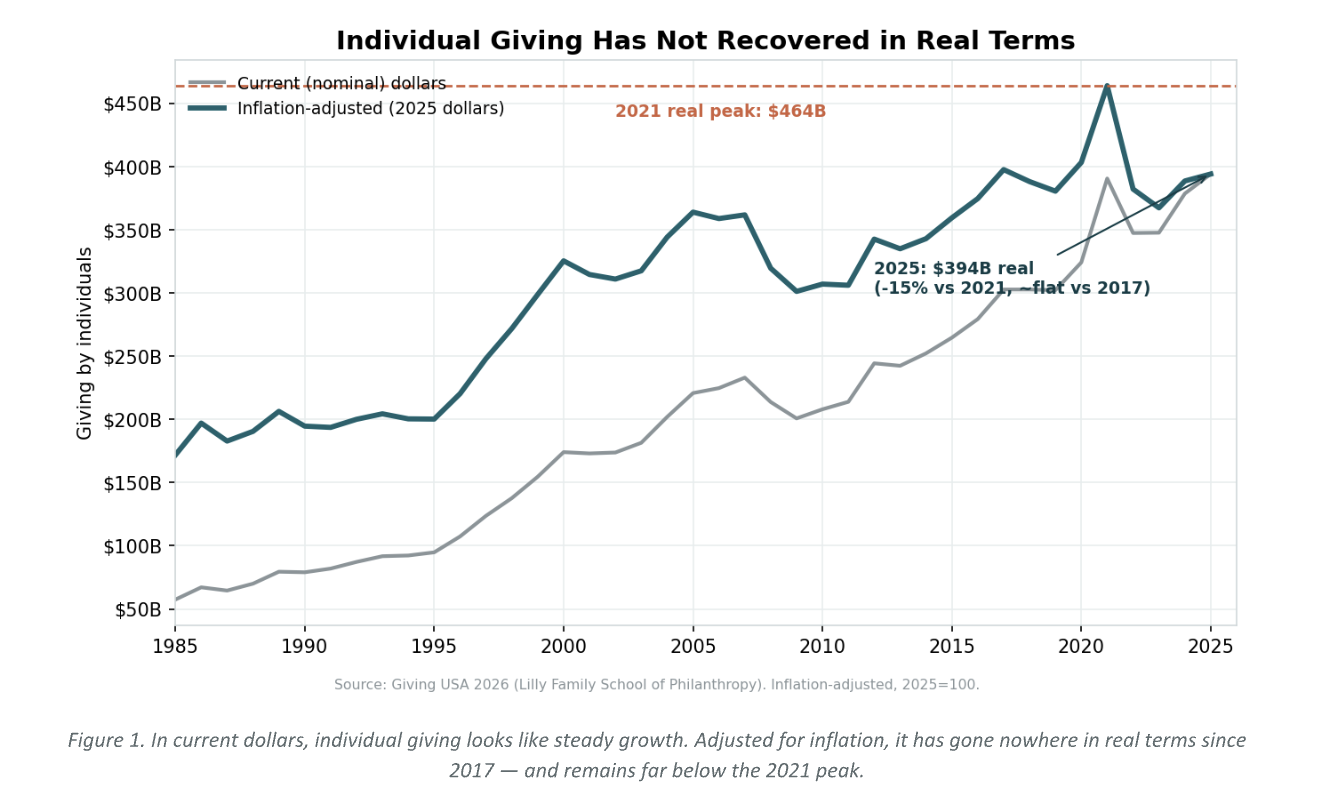
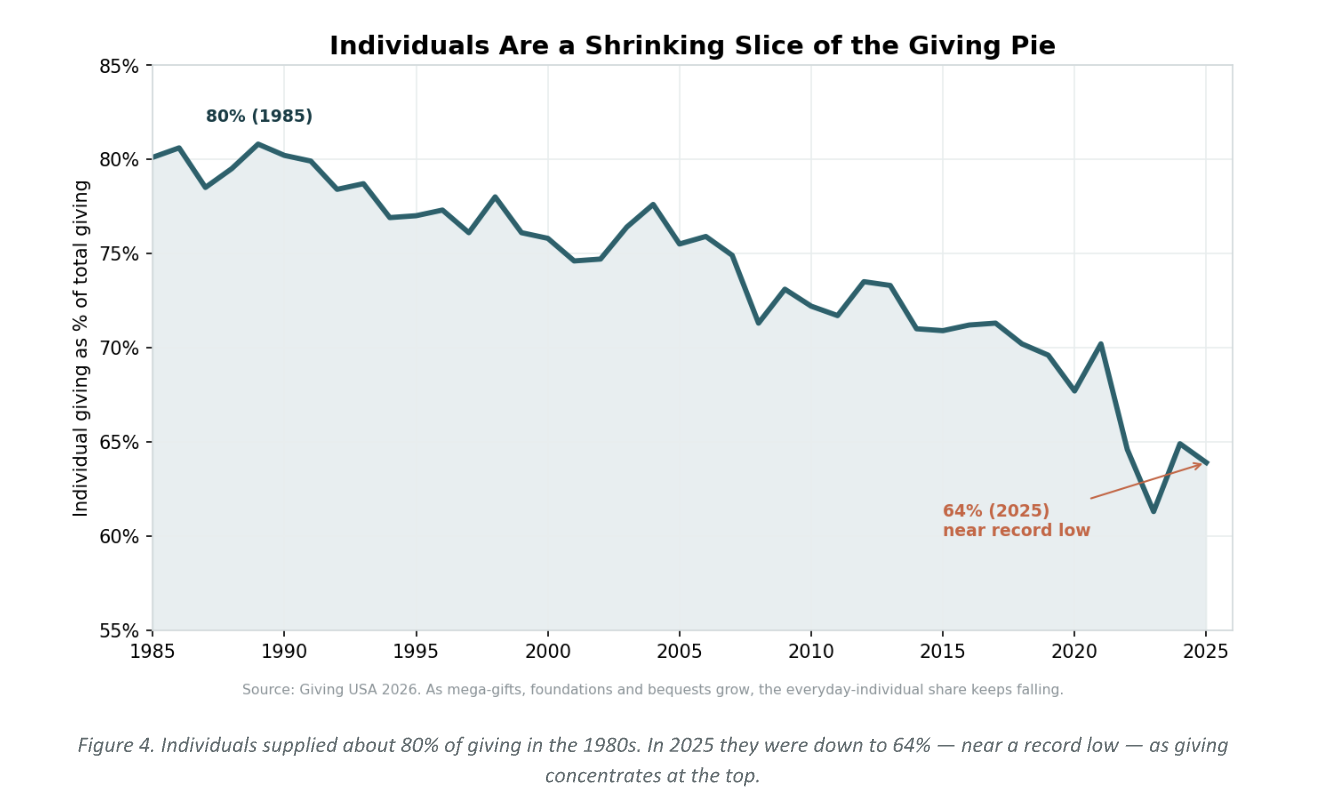
The most important number in Giving USA 2026 isn't $617 billion. It's the quiet erosion beneath it. In inflation-adjusted dollars, individual giving reached $394 billion in 2025 — still 15% below its 2021 peak and essentially flat compared with 2017. Eight years have passed with no real growth in what individuals give.
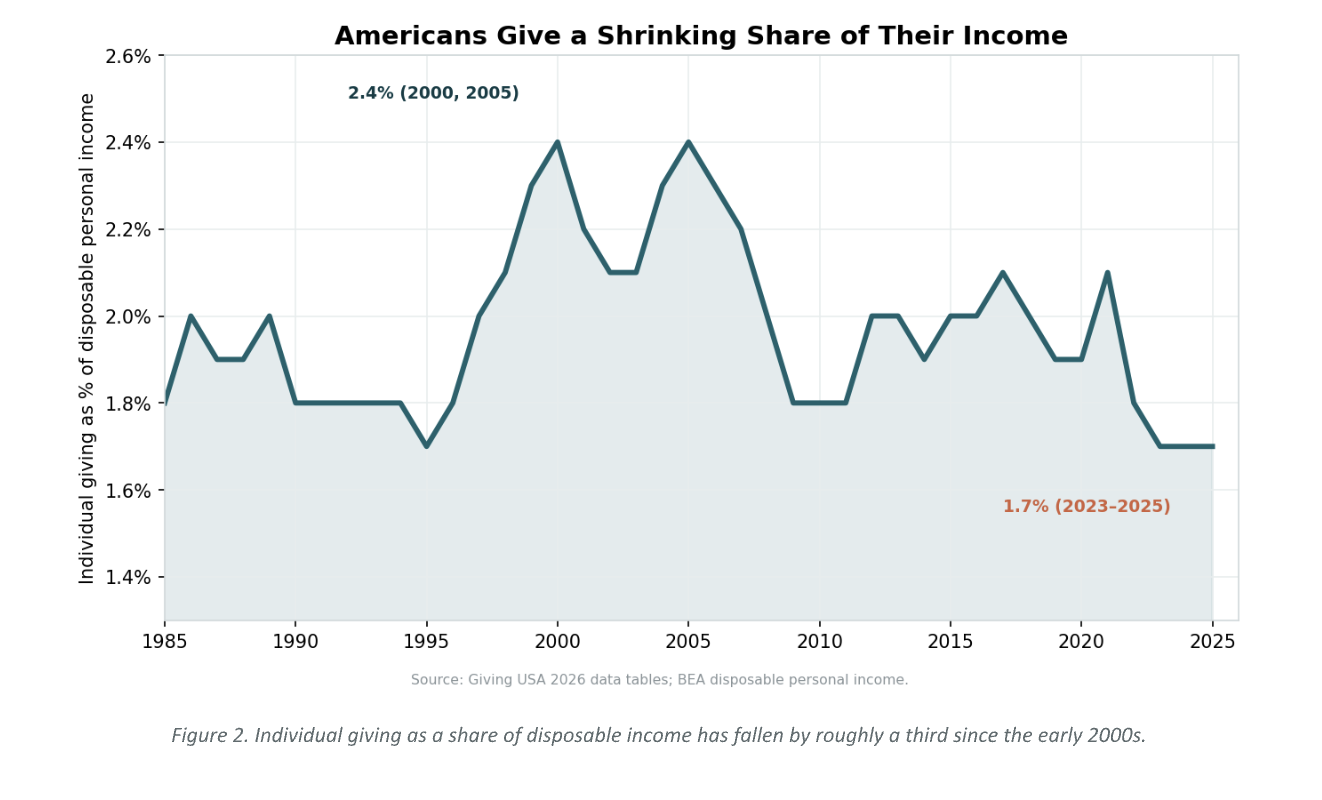
Measured against income, the slide is just as clear. Americans gave 1.7% of their disposable personal income in 2025 — down from 2.4% in 2000 and 2005. The charitable instinct of the typical household is weakening, not strengthening.
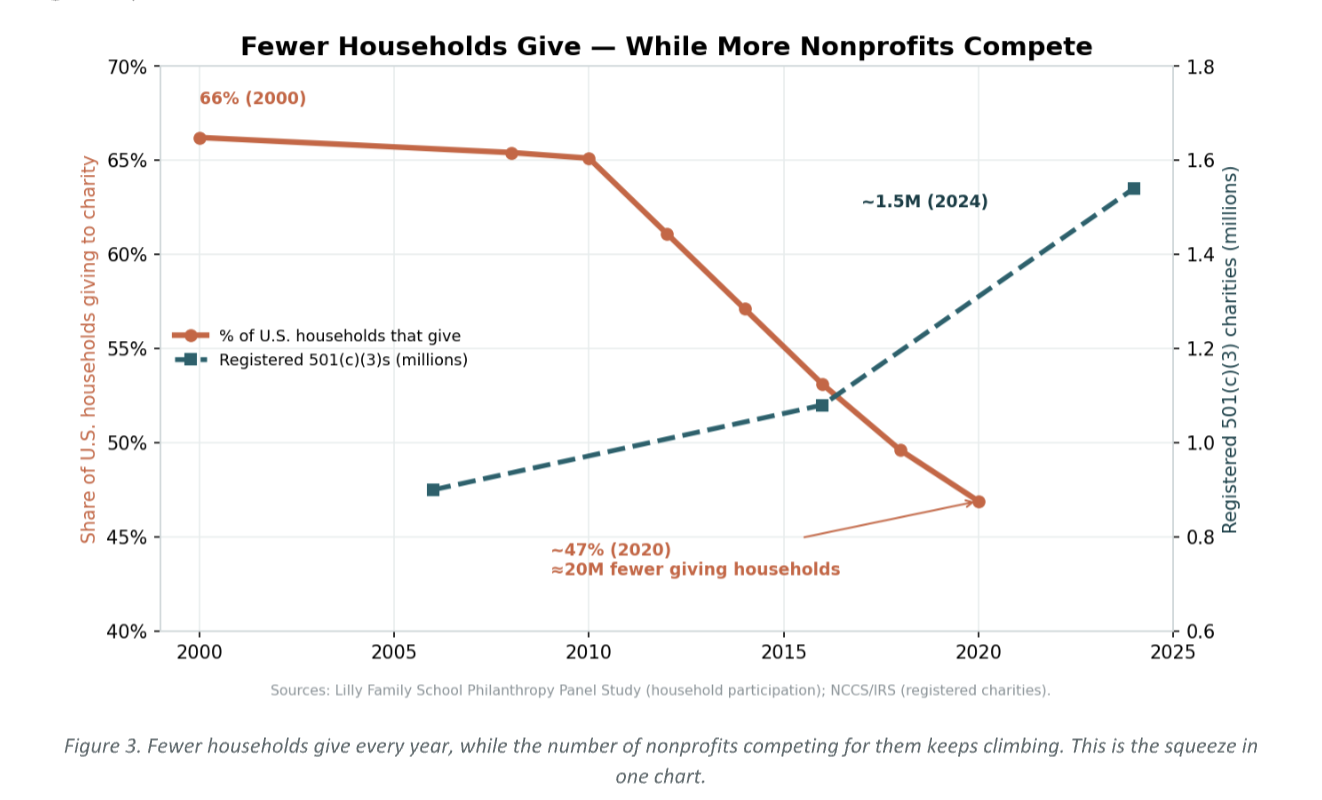
The most alarming trend isn't in Giving USA's dollar tables — it's in who gives. The share of U.S. households that donate to charity fell from 66% in 2000 to roughly 47% by 2020. That's about 20 million households that have left the donor pool entirely. Donor counts fell again in 2024. Meanwhile, the number of registered 501(c)(3) organizations grew from about 1.08 million a decade ago to roughly 1.5 million today — a 40% increase in the number of charities competing for a real-dollar pool that hasn't grown per household.
Add it up, and the picture is unambiguous: a flat real pool of individual money, supplied by a shrinking base of donors, divided among 40% more organizations. That is the definition of resources becoming harder to access — regardless of how big the national headline gets.
THE NUMBERS THAT MATTER $394B individual giving in 2025 — 15% below the 2021 real peak 1.7% of disposable income given — down from 2.4% in 2000 ~20 million fewer giving households since 2000 ~40% more registered charities competing than a decade ago
An honest caveat
One version of this argument overreaches: the claim that, in 2025 specifically, mega-gifts alone propped up the individual total. In fact, very large gifts dipped in 2025, so the year's 4.1% nominal rise wasn't a mega-gift mirage. The durable case isn't about subtracting one year's biggest checks; it's structural. Individuals now account for just 64% of all giving, near the lowest share ever recorded, as foundations, bequests, and a handful of enormous gifts claim a growing share.
The broad, reachable base of everyday donors is the part that's shrinking.
2. Bequests belong in your strategy — not your annual budget
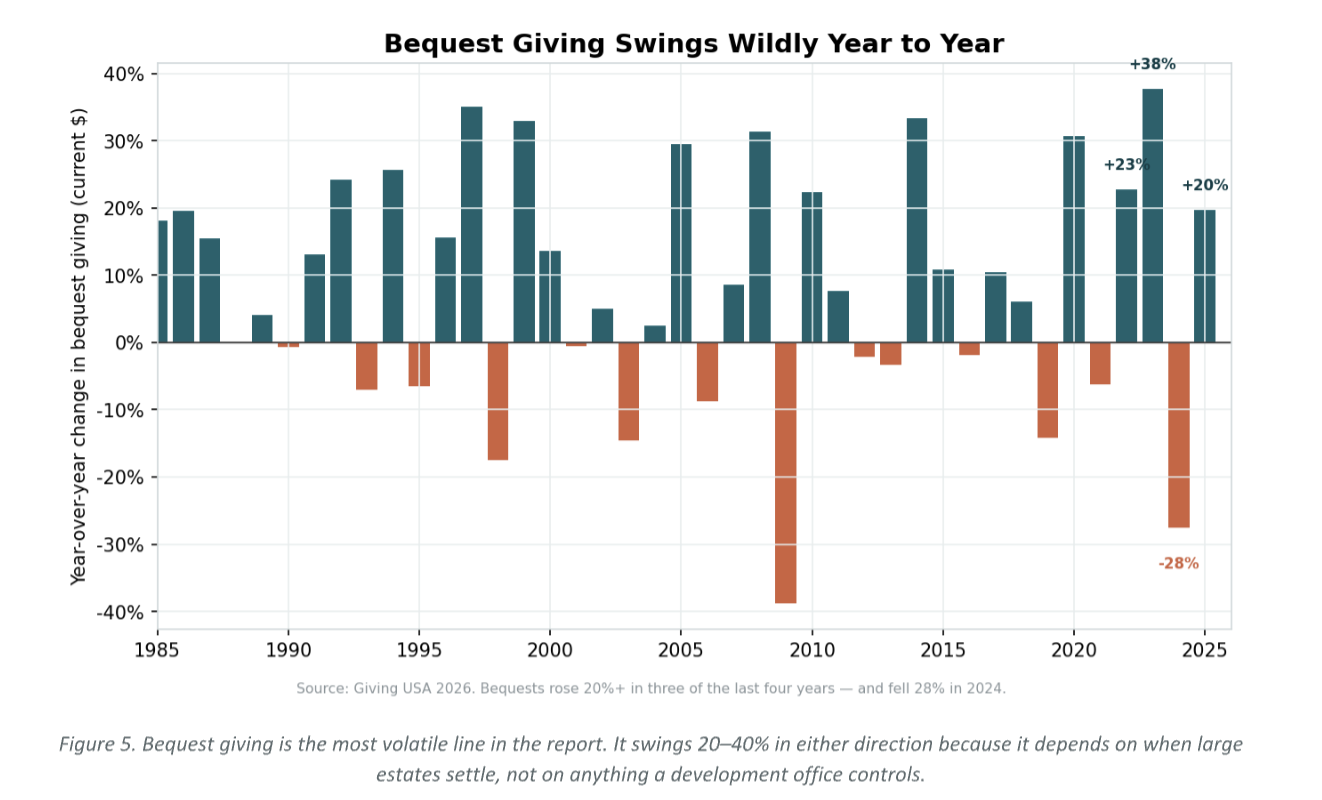
Bequest giving surged 19.7% in 2025 to $62 billion, and it's tempting to read that as a dependable new engine fueled by the much-discussed $84 trillion wealth transfer. The year-over-year pattern tells a different story. Bequests rose 22.7% in 2022, 37.7% in 2023, fell 27.6% in 2024, and rose again in 2025 — three 20%-plus surges and one steep collapse in just four years.
The mechanism explains the noise: bequests are realized when donors die and estates close, and a handful of very large estates can shift the national number by tens of percentage points in a single year.
That makes bequests genuinely important — about 10% of all U.S. giving — but impossible to budget for year to year. A revenue source you cannot time is a portfolio asset, not a paycheck. It should fund your endowment and your future, cultivated relentlessly through planned-giving programs; it should never be the line item your next operating year depends on. Notably, Giving USA's own analysts caution that, despite years of anticipation, the great wealth transfer has not yet produced explosive, sector-wide growth. Plan for it. Don't bank on it.
3. Corporate giving is stable — because it's an investment, not a gift
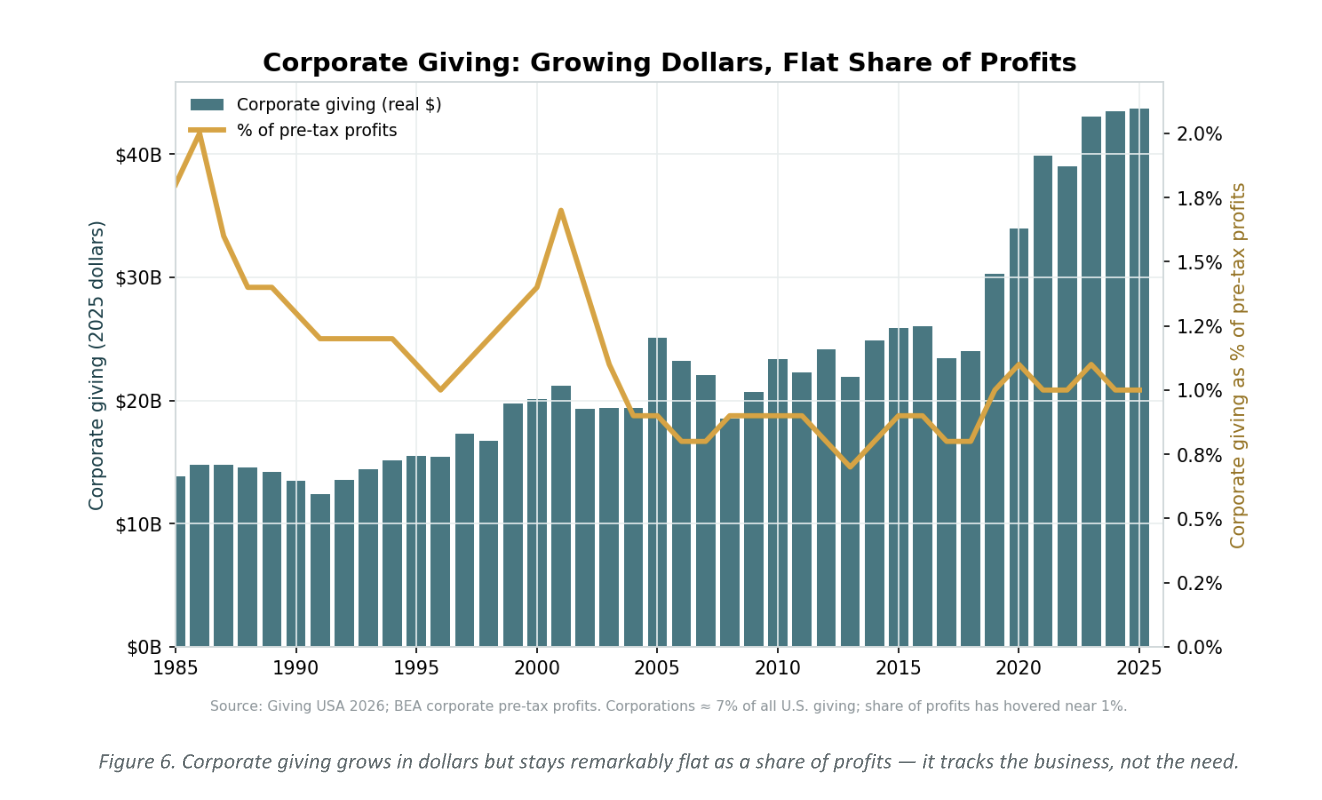
Corporate giving reached a record $43.67 billion in 2025 and has risen every year since 2019. It has also hovered near 1.0% of pre-tax corporate profits for two decades — predictable, profit-linked, and dependable. But the headline hides two things. First, after inflation, corporate giving grew just 0.5% in 2025, and the record was driven substantially by pharmaceutical in-kind donations rather than new cash. Second, and more importantly, corporate dollars are increasingly directed.
Today's corporate funders concentrate their giving in areas tied to business strategy — workforce, economic opportunity, and education — they expect measurable outcomes, real-time reporting, and employee engagement in return. They are buying social ROI, not goodwill. That makes corporate giving a leading indicator for all of philanthropy. Giving USA's special reports show the same shift among major individual donors, who increasingly demand impact measurement, proactive strategy, and hands-on engagement. The money, corporate and individual, is flowing toward demonstrated, measurable return.
WHAT IT ADDS UP TO
The pattern across all three theories: A shrinking, concentrating base of everyday giving. A lumpy bequest line you can't schedule. And the most dependable money is increasingly reserved for those who can prove a return. Every signal points the same way.
Why The Investment-Driven Model™ wins this moment
If the pool of available charity is shrinking and dependable funding is tied to proof of impact, then the organizations that thrive will be those that stop asking for charity and start offering investment. That is the premise of Convergent's Investment-Driven Model™ — and the 2026 data reads almost like a brief written in its favor.
Rather than relying on emotional appeals and small donations, the model demonstrates an organization's value through strategic alignment of three elements: fundraising objectives, the outcomes delivered, and the mission itself. It reframes the donor as an investor, the gift as a return-generating commitment, and the campaign as a sustainable funding stream rather than a one-time transaction. Where most consultants respond to a difficult market by urging nonprofits to send more appeals to a base that is actively shrinking, the investment-driven approach competes for the one pool that is genuinely growing: capital that follows measurable impact.
This isn't theory. Convergent's investment-driven campaigns secure roughly 70 cents in pledges for every dollar solicited and complete major capital and comprehensive campaigns in under 12 months. It is investor-grade discipline applied to the nonprofit sector across education, human services, arts and culture, healthcare, and economic development. In a year when the headline says everything is fine and the frontlines know better, that discipline is the difference between competing for a shrinking slice of charity and competing for investment.
THE TAKEAWAY
The bottom line: $617 billion is a real number and a misleading one. The donor base is thinner, the big money is lumpier, and the dependable money is reserved for those who can prove a return. The nonprofits that win the next decade won't be the ones that ask more often and harder. They'll be the ones that can show investors exactly what their dollars build.
Sources: Giving USA 2026 (Lilly Family School of Philanthropy / Giving USA Foundation) — data tables, infographic, and special reports on Impact Giving and Donor Confidence; Lilly Family School Philanthropy Panel Study; NCCS/Urban Institute and IRS nonprofit counts; Chronicle of Philanthropy and corporate-giving trend research (CECP, Benevity, Deloitte); Convergent Nonprofit Solutions, The Investment-Driven Model™.
With public sector dollars under pressure and anti-growth voices growing in intensity, economic development organizations are under increasing pressure to demonstrate measurable value. Stakeholders now expect clear evidence that investments deliver meaningful economic results. Funding is justified by outcomes, not activities.An outcome-based investment framework enables economic development organizations to link...Continue Reading
Many nonprofits struggle with unpredictable fundraising cycles, relying on short-term grants, annual campaigns, and event-based revenue streams. This reactive approach leaves organizations vulnerable to economic shifts, grant expirations, and donor fatigue. Your nonprofit may be feeling this stress right now, given the uncertainty in federal grant funding and shifting donor...Continue Reading
As a nonprofit leader, you know that to keep your organization afloat, you need to diversify your streams, including earning grants, executing capital campaigns, and securing major gifts. In your process of brainstorming revenue streams, you may not have considered one idea: investing.In this article, we’ll explore whether nonprofits can...Continue Reading
Share
Testimonials
Andrew Keenan
“The fact that Convergent could make the ask was huge. Working with our director and joining solicitations made me a better fundraiser – that was the right formula for us. Moving forward I feel much more confident in making asks and telling our story, and that is going to make us more sustainable in the long run.”
Andrew Keenan, Executive Director Callanwolde Fine Arts Center | Atlanta, GA
Lisa Zaken
“In the span of six short months, our Board went from being nervous about the initial campaign investment to being ecstatic with the attainment of our goal, and our subsequent stretch goal! Convergent can do it like no other. Their system is rigorous and extremely effective. We have nothing but great things to say about this organization!”
Lisa Zaken, President & CEO Leadership Gwinnett | Duluth, GA
Dion Davis
“The strategy and support offered by Convergent helped our Board expand its vision for the Foundation, which in turn helped to refocus and redefine our organization's impact in our community. The methodology behind their capital campaign process not only helps to raise more money in the immediate, but it also builds best practices for long-term investor relations and lays groundwork for the success of future funding initiatives.”
Dion Davis, Former Executive Director Jekyll Island Foundation | Jekyll Island, GA
Robin Mauck
“Working with Convergent has been a pleasure all the way around. Their approach is customized to your organization and their expertise is unmatched in the field. The Convergent team immersed themselves in our process, culture, and goals to provide exceptional value during our campaign. They truly walk alongside you every step of the way!”
Robin Mauck, Executive Director Obria Medical Clinics Gwinnett | Lawrenceville, GA
Aimee Hall
“I loved working with Convergent. I never could have done what Convergent did. If you want to run a successful campaign, you need to bring in that expertise. Thanks to their help, our capital campaign really took us to the next level within our community.”
Aimee Hall, Executive Director Safe Homes Domestic Violence Center | Augusta, GA
Phillip Aldridge
“I wanted to thank everyone from the Convergent team who assisted in our campaign. Of the varying ways the campaign’s success may be measured, I count it a blessing that we achieved what we did. Not just the funds committed but the contacts made, the level of exposure reached, and ultimately, what the funds and exposure mean in terms of how many more we now serve as a result. My thanks is in recognition and appreciation for Convergent serving as our fundraising counsel and for the patience and professionalism demonstrated throughout the campaign. You were a godsend for Valley Healthcare!”
Phillip Aldridge, Board Chair Valley Healthcare System | Colombus, GA
Jeff Taylor
“Early in our campaign feasibility study it became apparent that we lacked the Asking Rights necessary to conduct a capital campaign. As a result, Convergent’s knowledgeable consultants prepared an extensive plan of action that is a road map for growing our awareness and philanthropy. A successful capital campaign will be possible in the near future. Their entrepreneurial approach will definitely get you where you want to go.”
Jeff Taylor, CEO MedCura Health, formerly Oakhurst Medical Center | Stone Mountain, GA
Giving USA 2026 is being celebrated as a banner year. Look underneath the headline and a different story emerges — one that explains why an investment-driven approach to fundraising matters more now than at any point in the last 40 years.Americans gave a record $617.20...
Many nonprofits struggle with unpredictable fundraising cycles, relying on short-term grants, annual campaigns, and event-based revenue streams. This reactive approach leaves organizations vulnerable to economic shifts, grant expirations, and donor fatigue. Your nonprofit may be feeling this stress right now, given the uncertainty in federal...
With capital campaigns being multi-year commitments that can raise transformative funding for nonprofits, it’s natural that mission-driven organizations reach out to expert professionals for assistance with their upcoming campaigns. That’s where the capital campaign consultant can lend you their expertise and experience.Capital campaign consultants offer...
FOR IMMEDIATE RELEASEMarch 1, 2026For more information, contact:Brian Abernathy, General ManagerEmail: babernathy@convergentnonprofit.com Phone: 678.835.8735 ATLANTA, GA — At the International Economic Development Council Leadership Summit, March 1–3, Convergent announced its merger with Resource Development Group. Effective immediately, RDG will operate as RDG, a Convergent Company. This partnership unites...
Since nonprofit organizations rely on gifts from donors to support their mission, a thorough fundraising strategy is critical. However, even nonprofits with thorough funding plans run into obstacles at times, resulting in unmet goals and worries about sustainability and long-term plans.Whether you’re encountering times of...