Building Sustainable Capital Through Annual Giving
4 Sep 2026
Stable and predictable funding is the true foundation of long-term nonprofit health. That’s where a well-structured annual giving program makes all the difference. Your annual fund drives revenue for your nonprofit year-round, providing the unrestricted funds needed to direct resources where they are most critical, all while deepening community trust and building a healthy pipeline for future major gifts.
In this guide, we break down the essentials of building a resilient annual giving strategy that powers your daily operations, strengthens donor retention, and secures your mission's long-term future.
Throughout the rest of this article, you will see references to “investors.” That’s because at Convergent, we approach fundraising by positioning your organization as an irreplaceable community asset worthy of investment. By reframing donors as investors, we shift the focus away from one-time gifts and toward sustainable funding.
What is Annual Giving?
Annual giving is an ongoing fundraising program that secures repeatable, unrestricted donations each year to support its operations. Unlike grants or capital campaigns tied to specific projects, these unrestricted gifts give organizations the flexibility to cover overhead, administrative costs, and immediate program needs wherever they are most urgent.
Beyond supporting your nonprofit’s operations, annual giving is also one of the primary ways nonprofits acquire new investors. By encouraging supporters to give consistently, regardless of the donation size, annual giving fosters long-term loyalty and builds community trust.
Annual Giving vs Major Giving vs Capital Campaigns
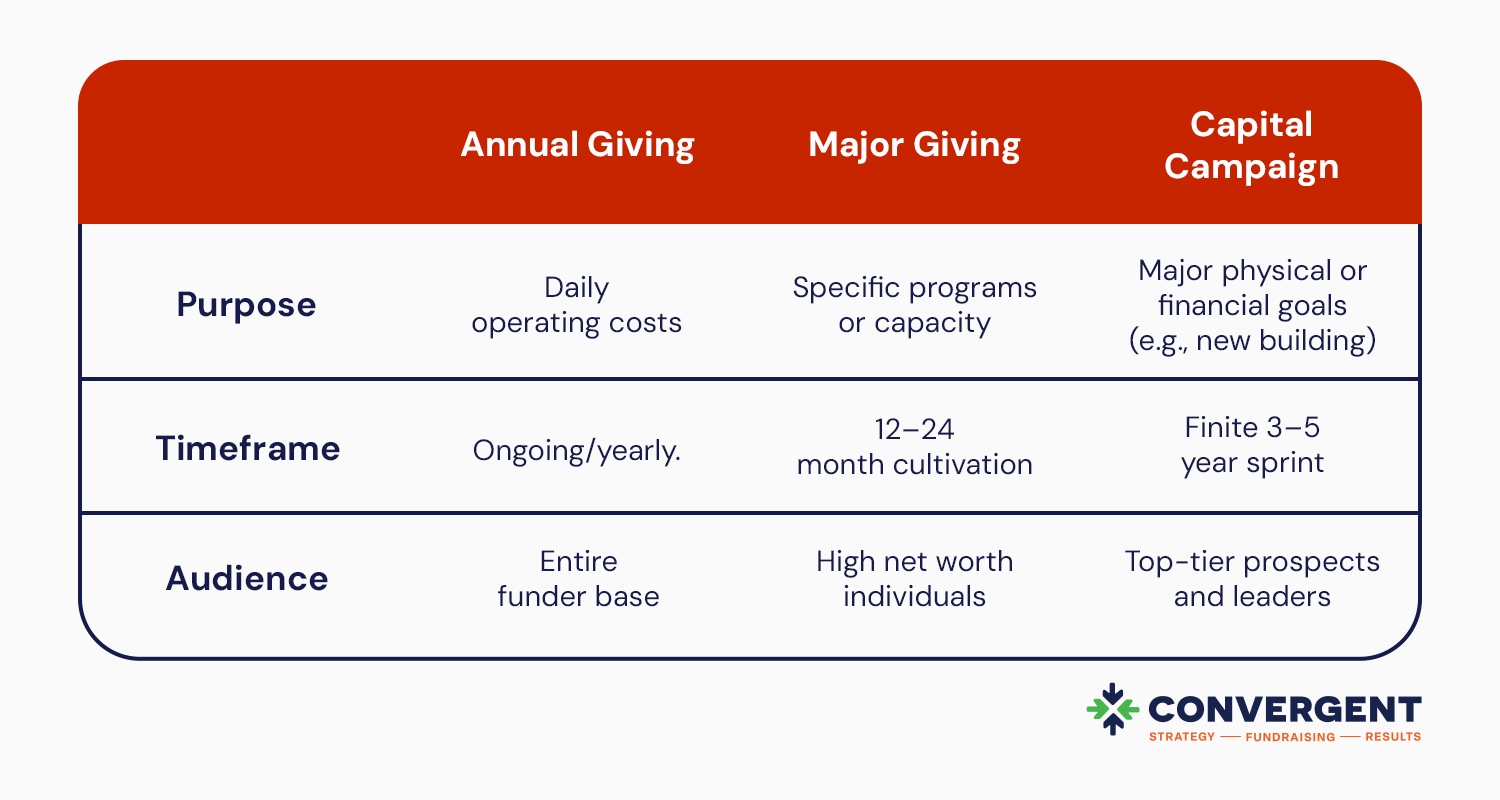
Annual giving, major gifts, and capital campaigns are three major sources of funding for nonprofits, and they are often confused with one another. Understanding how they differ allows you to engage investors at the right time with the right ask:
Annual giving: This channel secures steady contributions from a broad range of investors throughout the year. Its primary purpose is to provide unrestricted revenue that keeps daily operations running, covers overhead, and builds a base of loyal investors for the long term.
Major giving: This strategy focuses on securing large, high-impact donations, typically from wealthy individuals, family foundations, or corporations. These multi-year or one-off gifts usually fund program expansions, specialized initiatives, or strategic organization priorities.
Capital campaigns: These efforts are time-bound, intensive fundraising initiatives dedicated to a specific target, such as constructing new facilities, building an endowment, or securing long-term sustainability. Many nonprofits hire dedicated consultants to assist them with these campaigns.
While these three funding streams target different gift sizes and timelines, they don't operate in isolation. Aligning all three strategies ensures you aren't just raising funds for today's budget, but actively securing your nonprofit’s sustainability.
The Benefits of an Annual Giving Program
A strong annual fund shifts your strategy from reactive survival to confidently planning for the future. Here is how an annual giving program can benefit your organization:
Unrestricted cash flow: Annual giving provides flexible revenue to cover everyday operational needs outside of your organization’s main projects, such as electricity, payroll, and software subscriptions.
Budget stability: A healthy annual fund establishes a reliable baseline of recurring income. Knowing you have a dependable funding stream allows your leadership to draft annual budgets with certainty.
Major investor pipeline: The annual fund helps identify prospects for major investors. Supporters who give every year demonstrate deep commitment and affinity for your mission, making them potential prospects for major gifts, planned inheritances, and board leadership down the road.
Community proof: Major foundations and corporate sponsors look closely at local buy-in before awarding large grants. A broad, active base of annual supporters offers tangible proof that everyday people trust and value your mission in action.
While major grants and capital gifts fund big projects, the quiet consistency of the annual fund protects your mission during economic downturns, unexpected shifts, or leadership transitions. Investing in your annual giving program gives your leadership team the financial freedom to innovate, take strategic risks, and build lasting community trust without fear of sudden disruption.
Core Channels for Annual Giving
Your supporter base spans multiple generations, each with unique communication habits and giving preferences. To build a strong annual giving strategy, pick a few top channels to intentionally create a mix of outreach that reaches a broad range of supporters.
To reach as many investors as possible, consider how the following channels might fit into your strategy:
Website: Your website serves as the primary source of all information about your organization. Ensure that it is presentable, easy to navigate, and mobile-optimized so that it’s easy to support your mission financially. Make your content scannable by using bold subheadings and short paragraphs, and keep your CTAs prominent by making them high-contrast with the rest of your content.
Email campaigns: Email works best for timely impact updates, targeted calls to action, and driving instant traffic directly to your giving page.
Phone and text (SMS): SMS outreach provides a quick, personal touch for following up on mailed appeals, sending prompt text-to-give links, or simply calling to deliver a genuine thank-you.
Peer-to-peer fundraising: This channel empowers active supporters to advocate and raise funds on your behalf within their personal networks, often tied to events, walk-a-thons, or birthday campaigns.
The true impact of these tools comes from combining them into a cohesive experience. For example, an integrated campaign might start with a direct mail piece on an investor’s kitchen table, follow up with an email reinforcing the same story, and close with a brief text reminder on the campaign's final day.
Features of a Successful Annual Giving Campaign
A successful annual campaign goes beyond emotional appeals. It is a strategic process designed to show investors why your nonprofit is worthy of support. Framing your ask effectively helps investors see their contributions not as casual gifts but as active efforts toward solving pressing community needs.
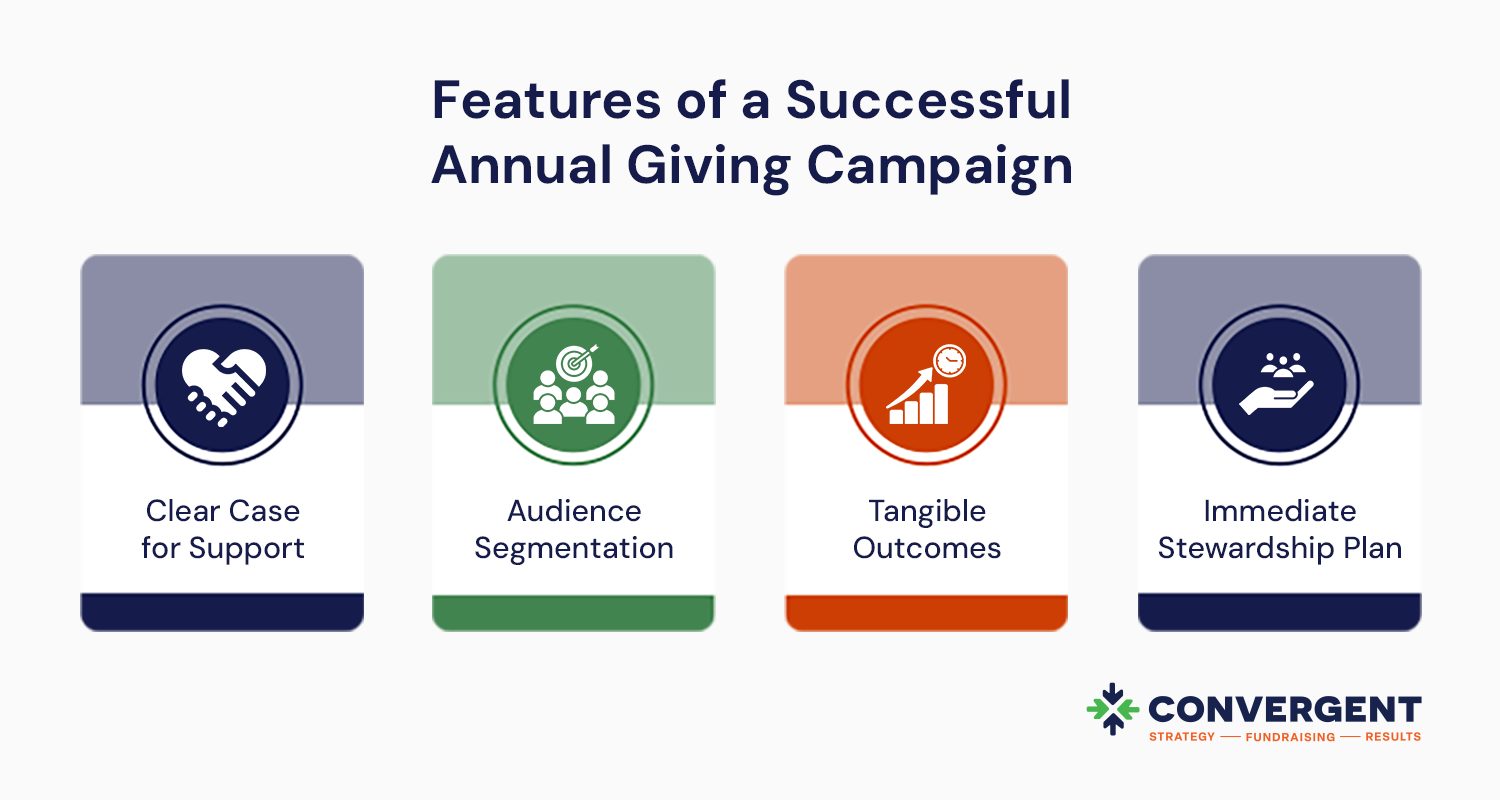
Every high-performing annual giving campaign relies on four fundamental elements:
Clear case for support: Vague requests for general support fall flat because investors need to know exactly why their gift matters right now. A clear case for support presents your nonprofit as a reliable partner capable of solving urgent community problems with tangible solutions.
Audience segmentation: Group your investors according to shared characteristics such as past giving history and engagement levels, and tailor both the messaging and the requested gift amount based on those details. For example, investors who have been consistently giving might receive a personalized letter highlighting the year's milestones, while first-time donors from the past year receive an email campaign celebrating what their initial contribution achieved.
Tangible outcomes: Investors need to see a direct link between their money and your mission. Showing exactly on your donation forms and impact reports what a $50, $100, or $500 gift accomplishes—both during the ask and in follow-up reports—turns a transaction into a meaningful investment tied to concrete results.
Immediate stewardship plan: The campaign doesn't end when the investor clicks "donate." Have thank-you letters, tax receipts, and follow-up impact reports lined up for deployment. This way, you keep the connection with your investors warm.
Ensuring that these elements are present in your annual giving program increases the likelihood of attracting new investors, as well as retaining existing ones. Audit your program and identify which of these elements are still missing so you can work on improving your strategy.
How Convergent Supports Annual Giving
While it is common for organizations to rely on emotional appeals to drive gifts and investments, Convergent uses a different approach. We demonstrate your nonprofit’s value to funders by emphasizing alignment on fundraising objectives, outcomes delivered, and your organization’s mission. By running comprehensive campaigns, we also prevent disconnected messaging that strains your relationships with your investors.
Our Investment-Driven Model™ grounds your fundraising in your real value. Our philosophy includes the following characteristics:
A focus on outcomes: We translate your work into clear Investable Outcomes™ and use an Organizational Value Proposition® (OVP) to highlight their true value. Showing nonprofit investors the exact impact and worth of your work allows them to evaluate whether your mission aligns with their priorities, driving larger and more sustainable financial commitments from those who feel passionately about your cause.
Positioning your organization as an asset: Convergent connects the money you raise to your nonprofit’s tangible results, positioning your nonprofit as a vital community asset. Once you deliver on these promised outcomes, you earn the right to secure ongoing funding, creating a reliable, long-term revenue.
Obtaining the power to ask: Delivering high-value outcomes earns your organization Asking Rights™, which is the ability to deliver outcomes that are valuable to investors. It also provides the credibility required to request significantly larger gifts.
Partnering with an experienced fundraising consultant like Convergent takes the guesswork out of building a sustainable annual giving program. By helping you articulate your true community value, refine your asks, and implement proven models, Convergent equips your leadership to secure predictable funding today while building a lasting foundation for the future.
Annual Giving FAQs
What does an annual giving officer do?
An Annual Giving Officer (AGO) focuses on broad-based, high-volume fundraising tactics designed to build a reliable base of annual donors. Unlike major gift officers who cultivate one-on-one relationships, an AGO works at scale to drive donor acquisition, retention, and annual upgrades.
What is the difference between recurring giving and annual giving?
Annual giving asks donors to support the organization's operating budget through donations collected yearly. Recurring giving is a specific payment method where a donor sets up automatic, ongoing contributions (usually monthly).
What is the difference between planned giving and annual giving?
Planned giving (also called legacy giving) is a specialized fundraising method where donors arrange to make a substantial gift to a nonprofit, usually as part of their overall financial or estate plan. Unlike annual gifts, which are typically made as a quick check or credit card payment from a donor's regular income, planned gifts are structured transfers drawn from a donor's accumulated assets (such as property, investments, or retirement accounts). While some planned gifts take effect during a donor's lifetime, most are realized upon their passing.
Should major supporters still be asked to contribute to the annual fund?
Yes. Many major funders view their annual fund contribution as their baseline community support, while reserving major gifts for special, one-off projects. Just ensure their annual fund asks are highly personalized and acknowledge their deeper relationship with your nonprofit.
Additional Resources
Shifting your annual giving model from a traditional emotional appeal to an investment-driven approach can feel daunting, but the long-term returns are transformative. Frame your goals around measurable impact to position your nonprofit not as a charity, but as a trusted partner driving real community change.
As you elevate your annual fundraising strategy, explore these key resources to guide your next steps:
"I entered into the nonprofit field immediately after college driven mostly by a passion for outreach with teens. After launching a program in a local high school, I realized the importance and critical value of operations. I could invest my time in relationships with a handful of students, or I could invest it in systems that would enable scalability to reach hundreds of students. From that point on, my drive was systems and efficiencies that maximize the desired result.
I’m often kidded that this even overlaps into my hobbies and personal time. I want to find ways to be better and more efficient in everything I do. At Convergent, I get to fulfill this desire every day. I work with our team of skilled professionals to help increase the impact of the nonprofit organizations we work with in communities across the country."
Brian has developed a broad range of nonprofit experience through his career. He has led launches of local chapters for international organizations, directed the operational aspects of brand-new nonprofits, and developed cross-sector partnerships to identify innovative solutions for community development.
Prior to joining Convergent, Brian served as campaign director with a regional firm that managed capital fundraising campaigns for nonprofits. There he focused on building, scaling, and executing complex projects while developing systems to drive operational efficiencies.
Every nonprofit organization has an important mission but not many can quantify and communicate the value proposition of the impact they desire to achieve. Brian has helped organizations across various sectors develop case statements and impact strategies to effectively communicate their outcomes to key stakeholders and investors. At Convergent, Brian works closely with our project directors on strategic direction, day-to-day operations, expense control, and ultimately fundraising success for our clients
Brian resides in Buford, Georgia, with his wife, two daughters, one dog, and eight chickens.
Summary of Experience
VP of Operations at First Community Development, supervised entire operations staff of fundraising professionals and multiple capital campaigns.
Led development of a coalition of community leaders from various sectors to create Breakthrough Norcross — a collective impact initiative focused on improving educational and economic outcomes for students.
A member of Leadership Georgia class of 2019.
Elder and Treasurer at Emmaus Church.
BA in Business Management with an emphasis on Marketing from Carson-Newman College in Jefferson City, Tennessee.
Completed graduate level coursework at Moody Bible Institute and Reformed Theological Seminary.
Did you know that while total charitable giving reached a record $617.20 billion in 2025, this milestone represents only a 3.0% increase when adjusted for inflation? In a landscape defined by constant economic volatility, how can your nonprofit secure the financial stability required to genuinely thrive?This is where recurring giving...
You already know that your board is responsible for leading your organization, but did you realize their engagement in fundraising will likely set the trajectory for your fundraising success? An engaged board should be an actively giving (and/or “getting”) board. Having the board’s full support is key to being ready for...
The public launch of an economic development fundraising campaign is an important milestone. It signals broad community engagement, visible investor commitment, and a shared vision for the future.Yet organizations that work with RDG, a Convergent Company understand that the launch is not the finish line, it is only the beginning...
Share
Testimonials
Andrew Keenan
“The fact that Convergent could make the ask was huge. Working with our director and joining solicitations made me a better fundraiser – that was the right formula for us. Moving forward I feel much more confident in making asks and telling our story, and that is going to make us more sustainable in the long run.”
Andrew Keenan, Executive Director Callanwolde Fine Arts Center | Atlanta, GA
Lisa Zaken
“In the span of six short months, our Board went from being nervous about the initial campaign investment to being ecstatic with the attainment of our goal, and our subsequent stretch goal! Convergent can do it like no other. Their system is rigorous and extremely effective. We have nothing but great things to say about this organization!”
Lisa Zaken, President & CEO Leadership Gwinnett | Duluth, GA
Dion Davis
“The strategy and support offered by Convergent helped our Board expand its vision for the Foundation, which in turn helped to refocus and redefine our organization's impact in our community. The methodology behind their capital campaign process not only helps to raise more money in the immediate, but it also builds best practices for long-term investor relations and lays groundwork for the success of future funding initiatives.”
Dion Davis, Former Executive Director Jekyll Island Foundation | Jekyll Island, GA
Robin Mauck
“Working with Convergent has been a pleasure all the way around. Their approach is customized to your organization and their expertise is unmatched in the field. The Convergent team immersed themselves in our process, culture, and goals to provide exceptional value during our campaign. They truly walk alongside you every step of the way!”
Robin Mauck, Executive Director Obria Medical Clinics Gwinnett | Lawrenceville, GA
Aimee Hall
“I loved working with Convergent. I never could have done what Convergent did. If you want to run a successful campaign, you need to bring in that expertise. Thanks to their help, our capital campaign really took us to the next level within our community.”
Aimee Hall, Executive Director Safe Homes Domestic Violence Center | Augusta, GA
Phillip Aldridge
“I wanted to thank everyone from the Convergent team who assisted in our campaign. Of the varying ways the campaign’s success may be measured, I count it a blessing that we achieved what we did. Not just the funds committed but the contacts made, the level of exposure reached, and ultimately, what the funds and exposure mean in terms of how many more we now serve as a result. My thanks is in recognition and appreciation for Convergent serving as our fundraising counsel and for the patience and professionalism demonstrated throughout the campaign. You were a godsend for Valley Healthcare!”
Phillip Aldridge, Board Chair Valley Healthcare System | Colombus, GA
Jeff Taylor
“Early in our campaign feasibility study it became apparent that we lacked the Asking Rights necessary to conduct a capital campaign. As a result, Convergent’s knowledgeable consultants prepared an extensive plan of action that is a road map for growing our awareness and philanthropy. A successful capital campaign will be possible in the near future. Their entrepreneurial approach will definitely get you where you want to go.”
Jeff Taylor, CEO MedCura Health, formerly Oakhurst Medical Center | Stone Mountain, GA
Giving USA 2026 is being celebrated as a banner year. Look underneath the headline and a different story emerges — one that explains why an investment-driven approach to fundraising matters more now than at any point in the last 40 years.Americans gave a record $617.20...
Many nonprofits struggle with unpredictable fundraising cycles, relying on short-term grants, annual campaigns, and event-based revenue streams. This reactive approach leaves organizations vulnerable to economic shifts, grant expirations, and donor fatigue. Your nonprofit may be feeling this stress right now, given the uncertainty in federal...
With capital campaigns being multi-year commitments that can raise transformative funding for nonprofits, it’s natural that mission-driven organizations reach out to expert professionals for assistance with their upcoming campaigns. That’s where the capital campaign consultant can lend you their expertise and experience.Capital campaign consultants offer...
FOR IMMEDIATE RELEASEMarch 1, 2026For more information, contact:Brian Abernathy, General ManagerEmail: babernathy@convergentnonprofit.com Phone: 678.835.8735 ATLANTA, GA — At the International Economic Development Council Leadership Summit, March 1–3, Convergent announced its merger with Resource Development Group. Effective immediately, RDG will operate as RDG, a Convergent Company. This partnership unites...
Since nonprofit organizations rely on gifts from donors to support their mission, a thorough fundraising strategy is critical. However, even nonprofits with thorough funding plans run into obstacles at times, resulting in unmet goals and worries about sustainability and long-term plans.Whether you’re encountering times of...