Major Giving Strategy: A Guide to Major Gift Fundraising
14 Sep 2026
Charitable giving recently crossed a historic milestone, surpassing $617 billion in a single year. Yet beneath this macro-level growth lies a challenging reality for the sector: the total pool of individual funders continues to contract. In 2025, the number of donors declined by about 3.6%, continuing a downward trend that began in 2021. As nonprofits come to rely on a smaller, high-capacity segment of contributors to fund their operations, maintaining the status quo is no longer viable.
Securing transformational gifts in this economic climate requires more than emotional appeals. High-net-worth funders evaluate gifts as social investments, demanding measurable impact, fiscal discipline, and demonstrated organizational credibility before committing financially. By structuring major giving as a disciplined, ROI-driven venture, development teams can build resilient, predictable revenue pipelines.
This guide breaks down everything you need to know about major giving to build a high-performing strategy, including:
As you read through this guide, you may see references to “investors” and “funders” rather than “donors.” That’s because at Convergent, we approach fundraising by positioning your nonprofit as an irreplaceable community asset worthy of investment. By reframing donors as investors, we shift the focus away from unpredictable one-time gifts toward sustainable funding from supporters who feel passionately about your mission.
FAQs About Major Giving for Nonprofits
Understanding the nuances of major giving helps nonprofit leaders structure better campaigns and set realistic internal expectations. Let’s take a look at the most common questions on this topic.
What are Major Gifts?
In standard fundraising practice, a major gift is the highest tier of charitable contribution an organization receives. It is typically categorized by its size relative to the nonprofit's total revenue rather than an arbitrary dollar threshold. Major gifts are often identified by how they are secured: unlike annual fund contributions, which are solicited through broad direct mail, email appeals, or events, major gifts are negotiated through sustained, one-on-one personal relationships between major gifts officers and the funder.
These contributions are rarely one-time checks. Instead, they often take the form of multi-year pledges or non-cash asset transfers—such as appreciated stock, real estate, or donor-advised funds (DAFs)—dedicated to capital projects, endowments, or high-priority strategic initiatives.
What Qualifies as a Major Gift?
What qualifies as a major gift depends entirely on an organization's annual operating budget and financial scale. A local grassroots nonprofit might classify any donation over $5,000 as a major gift, whereas a university or regional healthcare network may set its threshold at $50,000, $100,000, or $1,000,000. Rather than adhering to an arbitrary industry-wide dollar figure, nonprofits qualify major gifts by determining the specific giving tier that represents the top 10% to 15% of their total philanthropic revenue.
Why Is Major Giving Important for Long-Term Sustainability?
Major giving establishes predictable capital reserves that insulate organizations from economic changes and annual funder churn.
While smaller, one-time gifts are still important, especially to spread awareness of your nonprofit’s cause, their high acquisition costs and fluctuating retention rates may leave operating budgets vulnerable. By contrast, major gift fundraising secures multi-year pledges and substantial capital commitments, delivering a significantly higher ROI. Cultivating deep relationships with high-capacity funders helps organizations transition away from reactive, month-to-month survival, allowing leadership to plan strategic initiatives and multi-year programs with financial confidence.
What Is the Difference Between a Major Gift and a Mega Gift?
The distinction between a major gift and a mega gift comes down to operational scale, rarity, and leadership involvement.
A major gift aligns with an organization's established fundraising tiers (such as $10,000 to $1,000,000) and funds existing strategic priorities or capital campaigns. These gifts are pursued systematically by major gifts officers through standard cultivation lifecycles.
A mega gift, by contrast, is a rare eight- or nine-figure contribution (often $10 million or more) that fundamentally transforms an institution's operational footprint—such as naming an entire university, constructing a new regional facility, or creating a massive permanent endowment. Because of their size and legal complexity, mega gifts tend to be negotiated directly by the nonprofit’s executive director, board chair, and specialized wealth advisors.
How Long Does the Major Giving Fundraising Cycle Typically Take?
The major giving fundraising cycle typically requires 12 to 18 months from initial prospect identification to a completed financial commitment. Moving high-capacity funders through identification, qualification, relational cultivation, formal solicitation, and closing requires deliberate, sustained engagement.
This multi-month timeline reflects the thorough investigations high-net-worth individuals conduct before transferring significant capital. Large financial commitments frequently involve moving complex assets, which requires strategic tax planning and consultation with financial advisors. Systematically moving through discovery, cultivation, and formal proposal drafting protects the fundraising pipeline, ensuring fundraisers do not burn viable opportunities with premature or undersized solicitations.
What Is the First Step in Creating a Successful Major Giving Strategy?
The foundational step in building a major giving strategy is establishing internal readiness. Before reaching out to external prospects, leadership must formulate a concise, outcomes-based case for investment. This document must clearly articulate project scope, measurable community impact, exact financial requirements, and tangible ROI. Once board members commit their own financial resources to this plan, development staff can confidently approach external prospects with the assurance of total leadership alignment and support.
The Major Giving Lifecycle
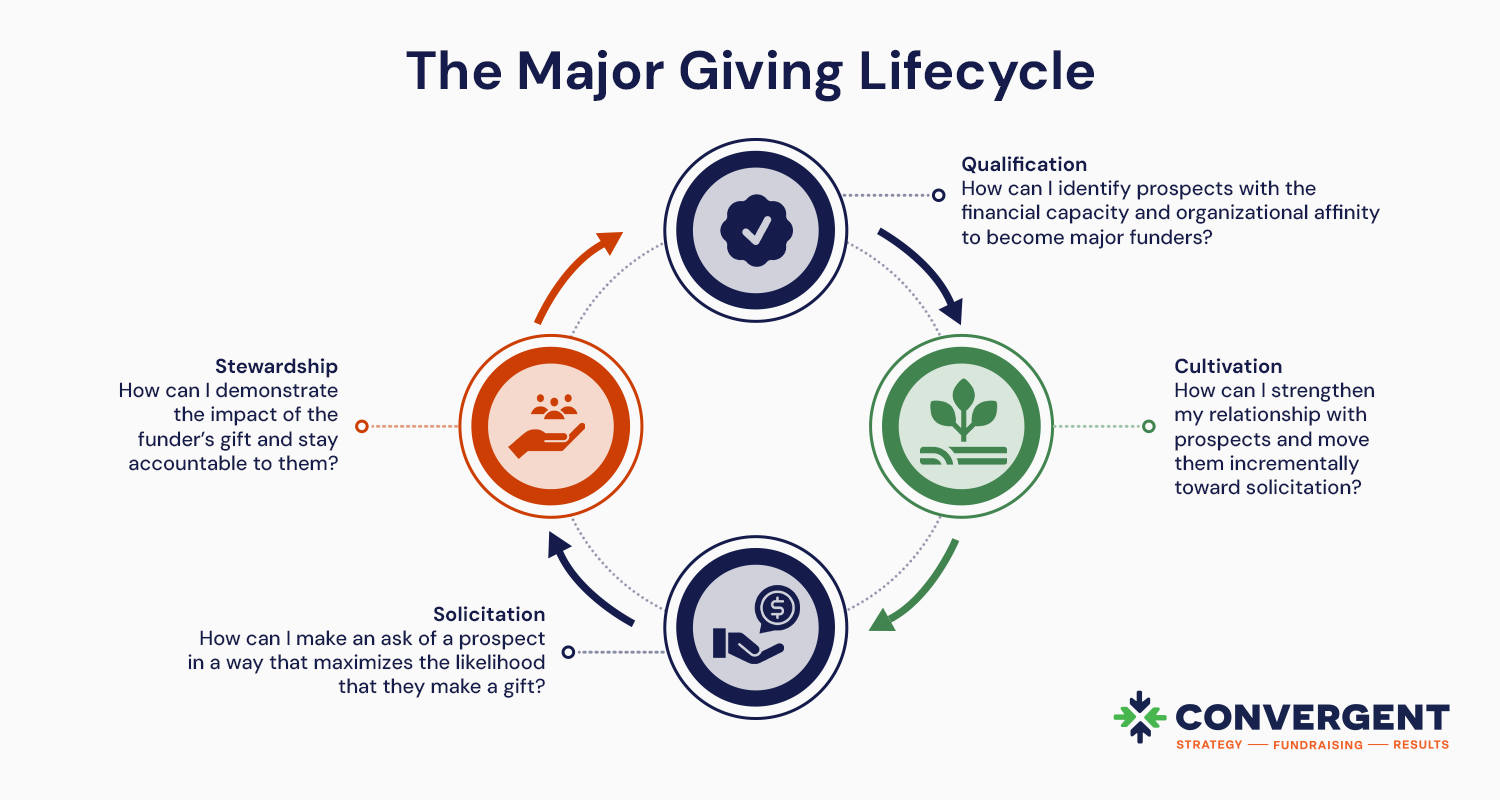
The major giving lifecycle systematically moves funders through a structured process from initial discovery to ongoing engagement. This phased approach lets fundraisers build authentic relational equity with prospective investors over time, enabling them to successfully close transformational gifts.
Qualification
Before investing resources, development teams must identify and qualify prospects to determine if they possess both the financial capacity and the organizational affinity necessary to become major investors.
Effective qualification saves hundreds of staff hours by filtering out low-affinity wealth prospects. A dedicated major gifts officer schedules exploratory discovery meetings to ask targeted questions about the prospect's philanthropic priorities, community goals, and personal connection to the cause. Only prospects who demonstrate both high capacity and high inclination should advance into the active pipeline.
Cultivation
Cultivation is the strategic process of aligning an investor's personal values and philanthropic priorities with your organization’s highest-priority strategic goals. Effective major gifts officers execute a series of purposeful, incremental touchpoints designed to move a prospect toward an active solicitation.
High-impact cultivation involves deep, individualized engagement opportunities, such as:
Executive briefings: Host private, one-on-one meetings with your executive director, CEO, or lead program staff to discuss strategic organizational direction and long-term vision.
Experiential site visits: Walk prospective investors through existing facilities, project sites, or community service centers so they witness your mission in action and understand the challenges firsthand.
Early strategic involvement: Share advanced drafts of programmatic plans or proposed capital initiatives, inviting their perspective as community stakeholders before public announcements.
Each touchpoint should deepen the funder's commitment, test their appetite for specific funding priorities, and set clear expectations for a future formal proposal.
Solicitation
Solicitation is the formal presentation of a specific, outcomes-based funding opportunity. When cultivation is executed well, the formal ask contains no surprises. Instead, it represents the natural culmination of prior conversations about organizational need, measurable community impact, and the investor's philanthropic intent.
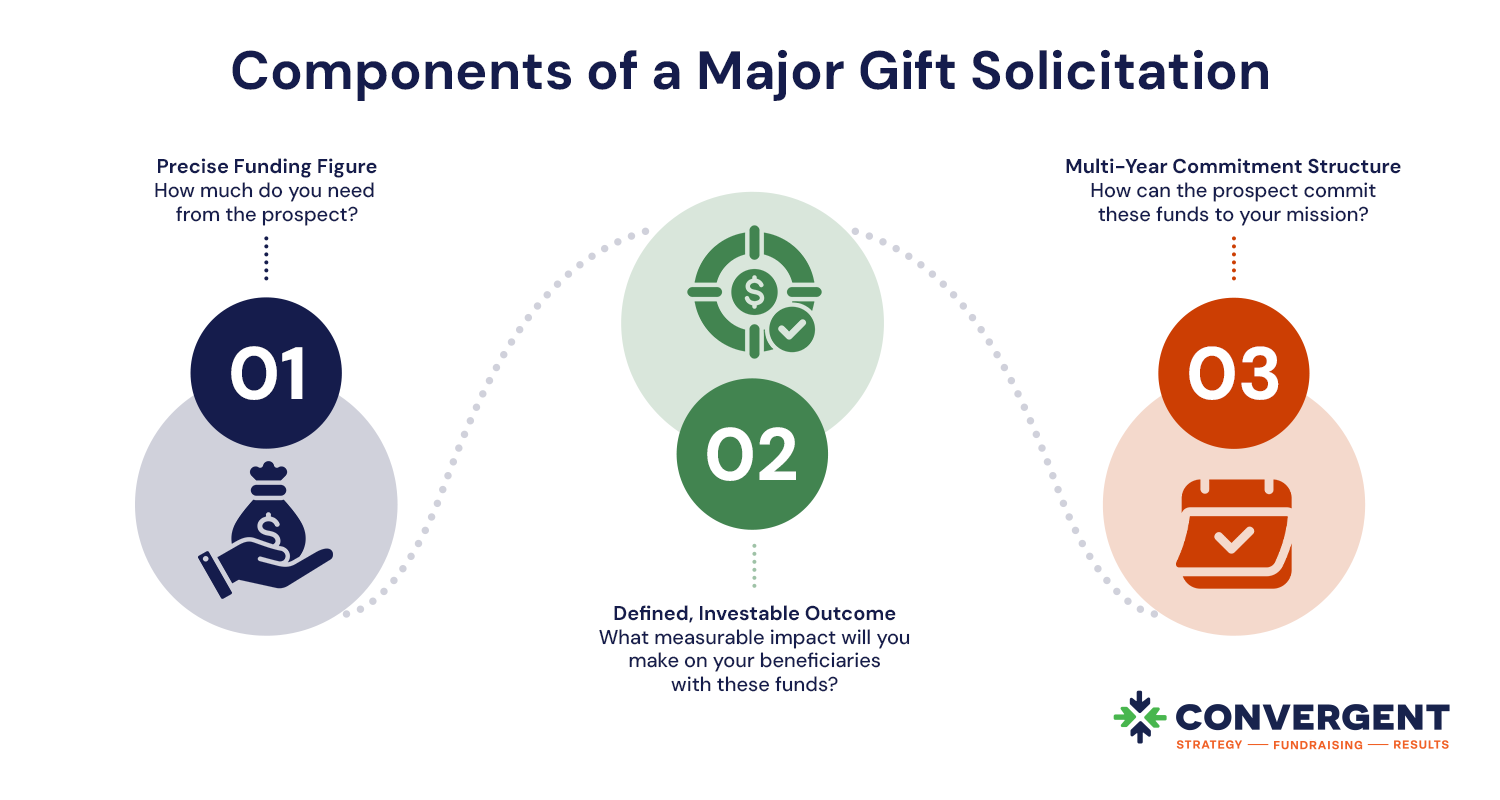
A successful major gift solicitation features three essential components:
A precise funding figure: Ask for a specific dollar amount tied directly to project requirements and the prospect's verified giving capacity.
A defined, investable outcome: Frame the request around measurable human or community impact—such as reducing regional youth unemployment by 20% or expanding permanent clinical access for 5,000 underserved patients—rather than activities, physical outputs, or general operational overhead.
A multi-year commitment structure: Structure pledges over a three-to-five-year timeline, making it easier for high-net-worth individuals to commit larger, transformational dollar amounts using both income and non-cash assets over a longer timeframe.
Solicitations are most effective when delivered in person by a two-person team—typically the major gifts officer managing the relationship alongside the executive director or a board member.
Stewardship
Stewardship is the systematic post-gift accountability framework that demonstrates organizational integrity. Once an investment is secured, the nonprofit must actively demonstrate that the capital was used responsibly and that the promised ROI was achieved.
A disciplined stewardship strategy might include the following elements:
Immediate recognition: Provide immediate gift acknowledgment, execute formal pledge agreements, and communicate personalized gratitude from both the executive director and board leadership—all within 30–60 days of the gift.
Milestone reporting: Deliver regular, transparent updates detailing exact programmatic or capital progress against the milestones established during the solicitation. Highlight key metrics, cleared operational hurdles, and community impact.
Deepened institutional engagement: Transition major investors into informal advisors or ambassadors by inviting them to exclusive project updates and involving them in future strategic discussions.
Rigorous stewardship transforms a one-time major donor into a lifetime institutional partner, thereby shortening the major giving cycle for that investor in future campaign commitments.
How to Maximize Your Major Giving Strategy
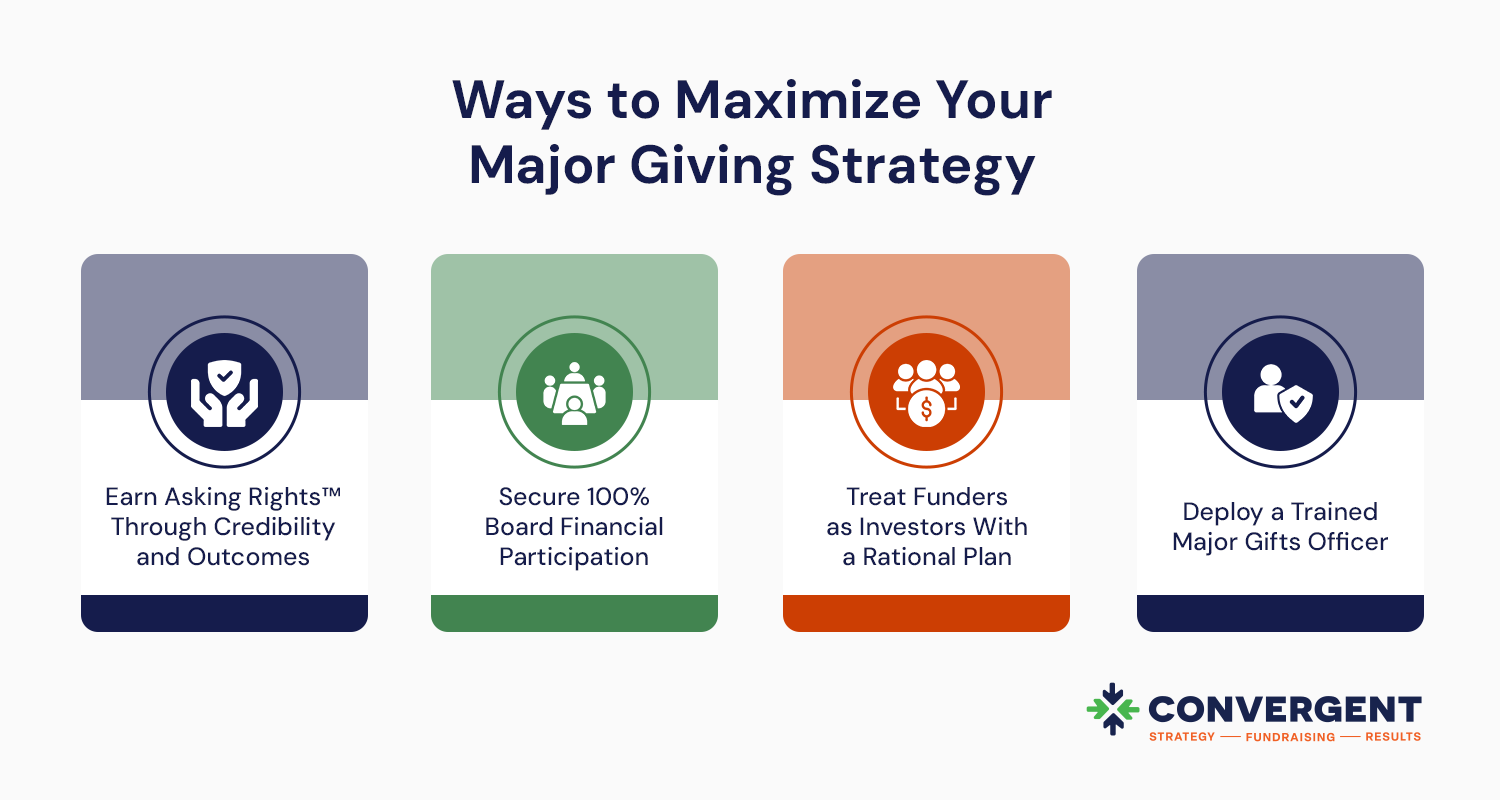
Maximizing your major giving strategy requires positioning fundraising requests as a rational case for investment. Nonprofits must earn the right to solicit external prospects by demonstrating internal commitment to their missions and clear, measurable outcomes.
Earn Asking Rights™ Through Credibility and Outcomes
Organizations earn Asking Rights™ by demonstrating credibility, fundraising skills, and concrete outcomes. This foundational step proves to potential investors that your nonprofit can effectively execute its vision.
Major investors evaluate nonprofit organizations with the same rigor venture capitalists apply to startup founders, focusing on three core criteria:
Operational and fiscal discipline: High-capacity investors review audited financial statements, IRS Form 990s, and reserve ratios to ensure the organization manages existing capital efficiently.
Measurable community outcomes: Funders look for concrete track records of delivered outcomes rather than emotional promises. You must demonstrate a clear history of meeting goals and a high standard of operational efficiency.
Competent leadership: Leadership must clearly articulate long-term plans, show deep knowledge of the community landscape, and present transparent execution roadmaps for future initiatives.
Without establishing this baseline credibility, attempts to solicit high-capacity donors may fall flat and even harm existing relationships.
Secure 100% Board Financial Participation
100% of a nonprofit's board should give financially before any external prospects are solicited. This establishes immediate credibility and proves internal buy-in for the nonprofit’s mission and campaign.
External investors, institutional foundations, and corporate partners treat governing board financial participation as an essential due diligence checkpoint. If board members—who possess intimate knowledge of the organization's governance, finances, and long-term potential—are unwilling to commit their own personal resources, external prospects have little incentive to shoulder the risk.
Securing total board participation creates a vital proof point for frontline gift officers, demonstrating that those closest to the mission stand firmly behind its financial plan.
Treat Funders as Investors With a Rational Plan
Funders are not traditional donors. They are investors who require a rational reason to support your nonprofit. Securing their buy-in involves presenting a highly specific plan that outlines exact programmatic costs and expected returns.
Traditional fundraising appeals rely heavily on emotion-based asks, such as appeals to sympathy by highlighting urgent operational deficits. Major gift investors instead look for strategic growth, operational scalability, and social ROI. Replace broad emotional appeals with a concise case for investment that answers these central questions:
What is the critical community problem? Define the challenge clearly with local data.
What is the scalable solution? Outline the specific operational intervention your organization will deploy.
What are the capital requirements? Provide transparent line-item budgets and implementation timelines.
What is the community ROI? Define the quantifiable outcome the community receives for every dollar invested.
Answering these four questions shifts the conversation away from scrutiny over overhead ratios and administrative percentages, areas where traditional donors may get bogged down. Sophisticated investors understand that transformational outcomes require operational capacity, skilled personnel, and modern infrastructure. By anchoring your proposal to verified costs and projected community yields, you center the conversation entirely on shared impact.
Deploy a Trained Major Gifts Officer
Tasking PR or community relations staff with asking for money often fails because they lack the specialized skills required. Successful major giving programs function through the work of a trained major gifts officer who knows how to pitch an investable outcome.
Closing major gifts requires structured sales discipline and financial negotiation. Frontline gift officers must be equipped to handle complex asset discussions (such as gifts of appreciated stock, real estate, or donor-advised funds) and comfortably navigate difficult financial objections during high-stakes solicitation meetings.
Evaluate major gifts officers on performance-based activity metrics—such as discovery meetings conducted, cultivation touchpoints delivered, and formal asks submitted—to ensure your team maintains consistent momentum toward your annual revenue targets.
Build Sustainable Major Giving with Convergent
Convergent provides the expertise needed to secure major gifts by framing your nonprofit's mission as an Investable Outcome™. Our team has decades of experience in the fundraising sphere, so we know the ins and outs of developing a strong major giving strategy.
With Convergent, you’re collaborating with fundraising consultants, not marketers. We work directly with your nonprofit’s staff and board to create and deliver a case for investment that guarantees a rational approach to major giving solicitations. We establish firm internal commitment before approaching external prospects. Then, we build out structured cultivation pathways, ensuring your team focuses exclusively on high-capacity individuals with genuine organizational affinity.
By transforming your emotional appeals into concrete financial propositions, Convergent equips your organization to secure the transformational capital required for long-term sustainability.
Additional Resources
Building a high-performing major giving program is ultimately an exercise in organizational maturity. As charitable giving increasingly concentrates into higher-capacity brackets, nonprofits that survive and scale will be those that abandon transactional, crisis-driven appeals in favor of disciplined investor relationships. By establishing internal readiness, articulating measurable community returns, and guiding prospects through an intentional lifecycle, your organization can insulate its mission against market volatility and build predictable, multi-year funding streams.
To take immediate action, audit your donor database this week to identify individuals who have consistently given mid-tier gifts over the past three years. These loyal supporters already understand your mission and represent your most viable, untapped major giving prospects.
To continue refining your development strategy and exploring advanced campaign structures, consult these additional resources:
"I entered into the nonprofit field immediately after college driven mostly by a passion for outreach with teens. After launching a program in a local high school, I realized the importance and critical value of operations. I could invest my time in relationships with a handful of students, or I could invest it in systems that would enable scalability to reach hundreds of students. From that point on, my drive was systems and efficiencies that maximize the desired result.
I’m often kidded that this even overlaps into my hobbies and personal time. I want to find ways to be better and more efficient in everything I do. At Convergent, I get to fulfill this desire every day. I work with our team of skilled professionals to help increase the impact of the nonprofit organizations we work with in communities across the country."
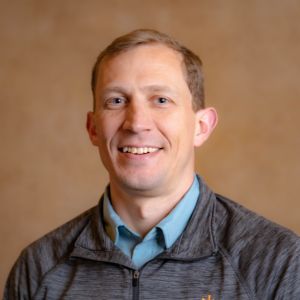
Brian has developed a broad range of nonprofit experience through his career. He has led launches of local chapters for international organizations, directed the operational aspects of brand-new nonprofits, and developed cross-sector partnerships to identify innovative solutions for community development.
Prior to joining Convergent, Brian served as campaign director with a regional firm that managed capital fundraising campaigns for nonprofits. There he focused on building, scaling, and executing complex projects while developing systems to drive operational efficiencies.
Every nonprofit organization has an important mission but not many can quantify and communicate the value proposition of the impact they desire to achieve. Brian has helped organizations across various sectors develop case statements and impact strategies to effectively communicate their outcomes to key stakeholders and investors. At Convergent, Brian works closely with our project directors on strategic direction, day-to-day operations, expense control, and ultimately fundraising success for our clients
Brian resides in Buford, Georgia, with his wife, two daughters, one dog, and eight chickens.
Summary of Experience
VP of Operations at First Community Development, supervised entire operations staff of fundraising professionals and multiple capital campaigns.
Led development of a coalition of community leaders from various sectors to create Breakthrough Norcross — a collective impact initiative focused on improving educational and economic outcomes for students.
A member of Leadership Georgia class of 2019.
Elder and Treasurer at Emmaus Church.
BA in Business Management with an emphasis on Marketing from Carson-Newman College in Jefferson City, Tennessee.
Completed graduate level coursework at Moody Bible Institute and Reformed Theological Seminary.
Stable and predictable funding is the true foundation of long-term nonprofit health. That’s where a well-structured annual giving program makes all the difference. Your annual fund drives revenue for your nonprofit year-round, providing the unrestricted funds needed to direct resources where they are most critical, all while deepening community trust...
Did you know that while total charitable giving reached a record $617.20 billion in 2025, this milestone represents only a 3.0% increase when adjusted for inflation? In a landscape defined by constant economic volatility, how can your nonprofit secure the financial stability required to genuinely thrive?This is where recurring giving...
You already know that your board is responsible for leading your organization, but did you realize their engagement in fundraising will likely set the trajectory for your fundraising success? An engaged board should be an actively giving (and/or “getting”) board. Having the board’s full support is key to being ready for...
Share
Testimonials
Andrew Keenan
“The fact that Convergent could make the ask was huge. Working with our director and joining solicitations made me a better fundraiser – that was the right formula for us. Moving forward I feel much more confident in making asks and telling our story, and that is going to make us more sustainable in the long run.”
Andrew Keenan, Executive Director Callanwolde Fine Arts Center | Atlanta, GA
Lisa Zaken
“In the span of six short months, our Board went from being nervous about the initial campaign investment to being ecstatic with the attainment of our goal, and our subsequent stretch goal! Convergent can do it like no other. Their system is rigorous and extremely effective. We have nothing but great things to say about this organization!”
Lisa Zaken, President & CEO Leadership Gwinnett | Duluth, GA
Dion Davis
“The strategy and support offered by Convergent helped our Board expand its vision for the Foundation, which in turn helped to refocus and redefine our organization's impact in our community. The methodology behind their capital campaign process not only helps to raise more money in the immediate, but it also builds best practices for long-term investor relations and lays groundwork for the success of future funding initiatives.”
Dion Davis, Former Executive Director Jekyll Island Foundation | Jekyll Island, GA
Robin Mauck
“Working with Convergent has been a pleasure all the way around. Their approach is customized to your organization and their expertise is unmatched in the field. The Convergent team immersed themselves in our process, culture, and goals to provide exceptional value during our campaign. They truly walk alongside you every step of the way!”
Robin Mauck, Executive Director Obria Medical Clinics Gwinnett | Lawrenceville, GA
Aimee Hall
“I loved working with Convergent. I never could have done what Convergent did. If you want to run a successful campaign, you need to bring in that expertise. Thanks to their help, our capital campaign really took us to the next level within our community.”
Aimee Hall, Executive Director Safe Homes Domestic Violence Center | Augusta, GA
Phillip Aldridge
“I wanted to thank everyone from the Convergent team who assisted in our campaign. Of the varying ways the campaign’s success may be measured, I count it a blessing that we achieved what we did. Not just the funds committed but the contacts made, the level of exposure reached, and ultimately, what the funds and exposure mean in terms of how many more we now serve as a result. My thanks is in recognition and appreciation for Convergent serving as our fundraising counsel and for the patience and professionalism demonstrated throughout the campaign. You were a godsend for Valley Healthcare!”
Phillip Aldridge, Board Chair Valley Healthcare System | Colombus, GA
Jeff Taylor
“Early in our campaign feasibility study it became apparent that we lacked the Asking Rights necessary to conduct a capital campaign. As a result, Convergent’s knowledgeable consultants prepared an extensive plan of action that is a road map for growing our awareness and philanthropy. A successful capital campaign will be possible in the near future. Their entrepreneurial approach will definitely get you where you want to go.”
Jeff Taylor, CEO MedCura Health, formerly Oakhurst Medical Center | Stone Mountain, GA
Giving USA 2026 is being celebrated as a banner year. Look underneath the headline and a different story emerges — one that explains why an investment-driven approach to fundraising matters more now than at any point in the last 40 years.Americans gave a record $617.20...
Many nonprofits struggle with unpredictable fundraising cycles, relying on short-term grants, annual campaigns, and event-based revenue streams. This reactive approach leaves organizations vulnerable to economic shifts, grant expirations, and donor fatigue. Your nonprofit may be feeling this stress right now, given the uncertainty in federal...
With capital campaigns being multi-year commitments that can raise transformative funding for nonprofits, it’s natural that mission-driven organizations reach out to expert professionals for assistance with their upcoming campaigns. That’s where the capital campaign consultant can lend you their expertise and experience.Capital campaign consultants offer...
FOR IMMEDIATE RELEASEMarch 1, 2026For more information, contact:Brian Abernathy, General ManagerEmail: babernathy@convergentnonprofit.com Phone: 678.835.8735 ATLANTA, GA — At the International Economic Development Council Leadership Summit, March 1–3, Convergent announced its merger with Resource Development Group. Effective immediately, RDG will operate as RDG, a Convergent Company. This partnership unites...
Since nonprofit organizations rely on gifts from donors to support their mission, a thorough fundraising strategy is critical. However, even nonprofits with thorough funding plans run into obstacles at times, resulting in unmet goals and worries about sustainability and long-term plans.Whether you’re encountering times of...